Planning for Outcomes-Based Assessment

Outcomes-Based Assessment (OBA) has been on our educator radar for years. I have the pleasure of working with groups of teachers throughout Saskatchewan to dig into what we know, what we wonder about and examine logistical barriers or problems to solve in order to move forward.

What do teachers know? What do teachers wonder about?

Used to Know I ThinkProfessional development needs to surface teacher knowledge, including any misconceptions that might exist. Too often, professional learning facilitators assume that educators do not know anything so begin from the beginning… or assume that educators know everything and are choosing to resist change. I would argue teachers know a lot… and they, as a collective, want to do best for students and learning. Just like in a classroom, misconstruction of knowledge can occur. It is our job as learning facilitators to use our formative assessment skills to expose understanding and misunderstanding so that we know what to do next.

When teachers are asked, What do you know about Outcomes-Based Assessment? Their answers might be similar to those generated in NLSD:

Know Complete

It is important when broad statements are made that they are clarified by the group.

  • Clarification may be needed on the term ‘learning behaviours’. These include things like attendance, behaviour, neatness, compliance with assignment expectations. Schools or systems may have other ways to communicate these ‘Hidden Curriculum’ expectations to students and parents outside of their academic achievement scores.
  • Clarification may be needed around the idea that assessment is based on “where they are at right now… can change over time”. An example where a student shows competency later in the year after that unit of study has been completed. This may raise some logistical questions around how this would work within a student information system or what impact this idea has on reporting. Once specific questions or logistical barriers surface, it is possible for a school or system to determine procedures so that they can have consistency.

As Tomas Guskey states, there is NO best practice in grading. There are ‘better’ practices that we want to embrace, but there is no universal, standardized and mechanical way to generate a grade for our students.  This was an empowering point with teachers to know that their professional judgment, based on an understanding of curricular outcomes and observable student behaviours, is the most important assessment practice. 

question mark

Along with what educators know, it is vital that we surface what they wonder about. Questions can frame teachers’ professional inquiry for a day of learning, as well as indicate what they need to be emphasized within the agenda. Typical questions around this topic may be:

  • How do I translate an outcomes-based assessment rubric into a %?
  • How do we gather, translate and score observations and conversations so that they ‘count’ like products?
  • What might a teacher daybook/unit plan look like using outcomes-based assessment?
  • Is all assessment outcome-based assessment?
  • What do we do if an assignment is late or not handed in?
  • What is the minimum/maximum number of indicators that we need to assess in order to maintain the integrity of the outcome?
  • How do we use outcome-based assessment in cross-curricular teaching?

It is important that participants choose which question(s) they are most invested in to solve, and provided time within a professional learning experience to discuss possible solutions with colleagues.

Assessment practices are founded on both beliefs and knowledge. A Talking Points Strategy can help to have small groups explore and surface their beliefs about assessment.

Starting with Curriculum

Learning targets are based on curricular outcomes. There are a number of different unit and lesson planning templates used in education. One useful process is to use a thinking map. This graphic organizer allows us to see the connections amongst curricular outcomes, instructional activities and assessment criteria.

Unpacking Outcomes

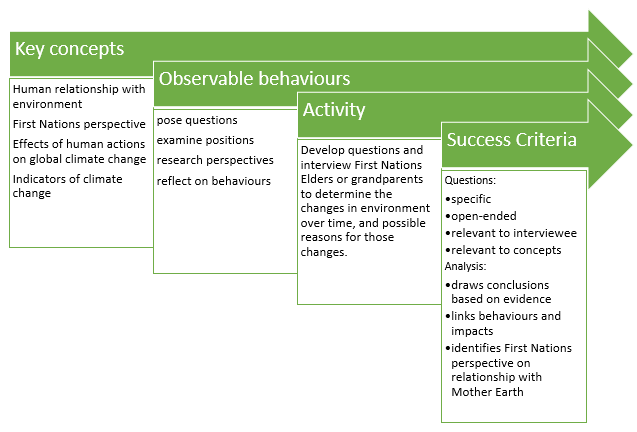
Starting in the centre, teachers can identify the connections between the nouns (concepts) and verbs (observable behaviours) of the curriculum with the activities that allow students to show those behaviours. The assessment criteria should be related to the curriculum rather than the activity.

For example, in Saskatchewan Science 10, one part of the SCI10-CD1 Outcome: Assess the implications of human actions on the local and global climate and the sustainability of ecosystems. Some of the indicators related to this outcome might be addressed in the following progression:
Outcome Unpacking

By unpacking into a circular thinking map, it is possible to see how the concepts and observable behaviours work together. This will lead to a holistic view of curriculum that eradicates the question of how many indicators are important to address.

Principles of Assessment

Rick Stiggins has developed a set of key ideas related to classroom assessment:
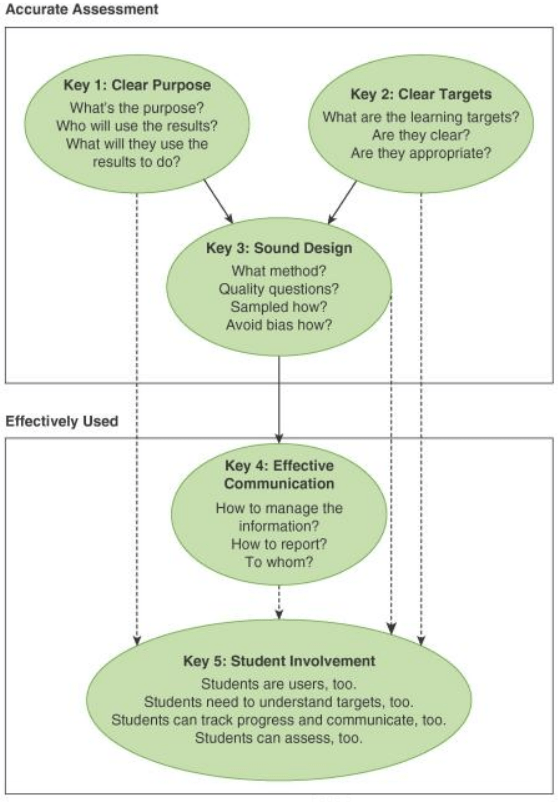
Stiggins Principles

(Chapuis, Commodore, Stiggins, 2016)

From Criteria to Rubrics

There are a variety of assessment tools, including checklists, portfolios, and rubrics. They all rely on clear learning targets or criteria for student success. What does success look like? What are we looking for?

Criteria Statements

Expanding on clear learning targets, Sue Brookhart shares some of her ideas on building high-quality rubrics.

Description Statements

Rubric Pitfalls

Sue Brookhart’s ideas have been incorporated into this simple editable Rubric Worksheet.

Used to Know I Think 3

Formative and Summative Assessment

Too often, formative assessment is defined as ‘things that are not marked’, while summative assessment is defined as “things that are graded at the end of a unit”. This implies that learners can only show understanding that ‘counts’ at the end of a unit of study. So what happens to all of their thinking, work and brilliance along the way? Is it possible that a learning and assessment experience might be both or either for different students? Is it possible that formative and summative assessment are interconnected?

Definitions

One definition for assessment is the ways in which instructors gather data about their teaching and students’ learning (Northern Illinois University, Faculty Development and Instructional Design Center). This definition implies that assessment’s purpose is multi-faceted – to inform students and teachers regarding student understanding as well as to inform teachers about their practice in teaching. Assessment, whether it is formative or summative, is a snap-shot in time that changes with instruction and understanding.
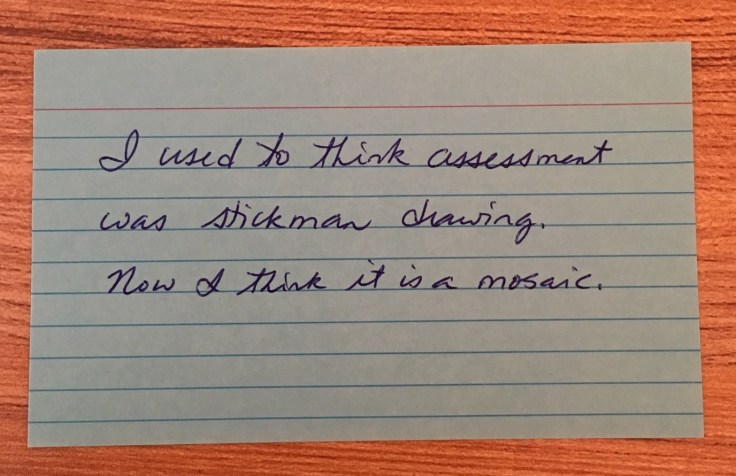
Used to Know I Think 1

Formative Assessment

In his book, Embedding Formative Assessment, Dylan Wiliam defines Formative Assessment as:

“An assessment functions formatively to the extent that evidence about student achievement is elicited, interpreted, and used by teachers, learners, or their peers to make decisions about the next steps in instruction that are likely to be better, or better founded, than the decisions they would have made in the absence of that evidence” (Wiliam, 2011).

This definition implies:

  • Formative describes the function of the assessment rather than the form.
  • Teachers, students and peers might be involved in deciding how to respond to assessment information.
  • There must be a responsive action based on the data in order for the assessment to be formative. Responsive actions are instructional in nature.

If formative assessments are designed with no clear decision/action implied, then the assessment is not useful. The five key strategies for improving student achievement through formative assessment are:

Who Where the learner is going Where the learner is now How to get there
Teacher 1. Clarifying, sharing and understanding learning intentions and criteria for success. 2. Engineering effective classroom discussions, activities, and tasks that elicit evidence of learning. 3. Providing feedback that moves learning forward.
Peer 4. Activating learners as instructional resources for each other.
Learner 5. Activating learners as owners of their own learning.

(Wiliam, 2011, p. 46)

Summative Assessment

Summative assessment is often described as providing information about or evaluating the attainment of understanding or achievement compared to a standard. Katie White (Softening the Edges, 2017) has created a holistic view of summative assessment as part of a larger assessment cycle.

“We engage in formative assessment, feedback and self-assessment regularly. Only after all this do we verify proficiency with summative assessment. It is at this point that we make professional judgments about whether to re-enter the learning cycle because proficiency has not yet been reached or to transition into enrichment or the next learning goal… Viewing summative assessment as part of a larger continuous cycle frees us to make decisions that are right for our learners and right for ourselves” (White, 2017, p. 139).

Formative Summative Cycle

(The Learning and Assessment Experience at UNSW)

The goal of summative assessment is to evaluate student learning. When viewed as part of a cycle, we can see that an assessment intended to be summative may, in fact, become formative. Similarly, there may be times that an assessment intended to be formative might become summative if a learner is able to show proficiency during that experience.

If we view the terms formative and summative as how the assessment is used rather than the tool or the intent for use, it can help us to see all experiences as part of a larger assessment plan.
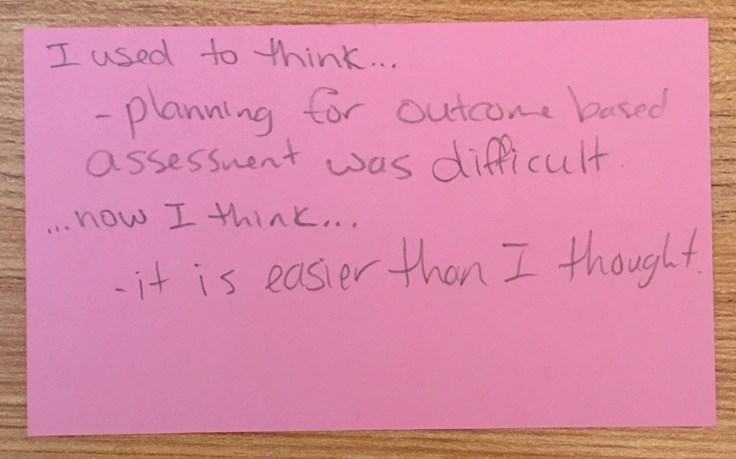
Used to Know I Think 2

Brookhart, S. (2013). How to Create and Use Rubrics for Formative Assessment and Grading. Alexandria: ASCD.

Chappuis, S. J., Commodore, D. C., & Stiggins, R. J. (2016). Balanced Assessment Systems: Leadership, Quality and the Role of Classroom Assessment. Thousand Oaks: Corwin.

Guskey, T. R. (2019, February 28). Let’s Give Up The Search for ‘Best Practices’ in Grading. Retrieved from Thomas R. Guskey & Associates: http://tguskey.com/lets-give-up-the-search-for-best-practices-in-grading/

UNSW Sydney. (n.d.). Guide to Assessment. Retrieved March 12, 2019, from UNSW Student Home: https://student.unsw.edu.au/assessments

White, K. (2017). Softening the Edges. Bloomington: Solution Tree.

Wiliam, D. (2011). Embedded formative assessment. Bloomington, Indiana, United States of America: Solution Tree Press.



Math Instruction for ALL Students

This blog post is a work in progress! Be sure to come back and visit in a few weeks, as I will be adding to it over time…

It can sometimes feel overwhelming when we look at all of the individual and group needs of our mathematics learners. Building readiness to learn, along with ensuring that we meet the individual needs of students might give us the impression that we need to create an individual lesson plan for each and every person in our classrooms. That sounds exhausting…

But what if we can create structures and use a variety of math instructional strategies within those structures? What if we can create diverse learning experiences that encourage mathematical thinking and growth over key concepts? This is an idea worth investigating!

I am still learning

Our elementary and middle years math curricula in Saskatchewan cover a number of topics, from number to patterns to shape and space and statistics. Ironically, when you look at the skills needed for students to be READY to engage in these grade-level concepts, there are only a handful of pre-skills. These pre-skills are the math concepts that are applied and used in new learning.

For example, when we are learning about adding and subtracting fractions, we need to know about:

  • addition and subtraction
  • multiplication and division, multiples and factors
  • what a fraction is, finding equivalent fractions, improper fractions

So, how do we teach and reteach each of these key concepts in our classrooms? You can find a large number of curated resources in this Google Drive which contains folders of resources

  1. Number Sense and Place Value
  2. Addition and Subtraction
  3. Multiplication and Division
  4. Parts of a Whole – Fractions, Decimals and Percent
  5. Algebraic Thinking

 These folders are designed to help you to teach through these continuums as well as:

  • What is an instructional sequence and strategies for teaching each concept?
  • What are some common misconceptions and how might we address them?
  • How might we infuse technology into our mathematics instruction?
  • What are some fun ways to engage in mathematics?
  • How might we use math with a purpose to gain a deeper understanding of social issues?

Concept Continuums

When we look at our Saskatchewan curriculum, we can see how concepts grow over time in these math Curricular Through Lines:

We can also pull out specific concepts and see how they grow. The following concept trajectories were created by a province-wide math leadership group a number of years ago, and show the language, strategies and concepts over time. Each continuum has four instructional strategies listed.

The Circle of Courage: Building Resilience

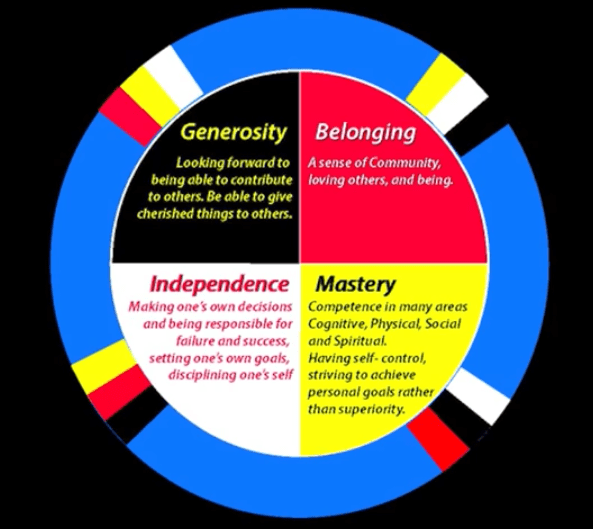
In their book, Reclaiming Youth at Risk, Brendtro, Brokenleg and Van Bockern (1990) proposed a model of youth empowerment and resiliency. This model is called the Circle of Courage, and it is based on research of First Nations philosophy of child rearing. The Circle of Courage is a holistic approach that is described by Dr. Martin Brokenleg in his video.

Dr. Brokenleg’s research shows that every human being has four basic needs: significance, competence, power and virtue. The Circle of Courage makes the following connections:


Circle of Courage Stems

Dr. Brokenleg has identified what it looks like in someone whose spirit is in a state of weakness, a state of strength, and what might happen if their spirit has been distorted. The following are ideas to support a state of strength by helping to mend a broken spirit.

Circle of Courage Graphic

Belonging: Right now, I belong here.

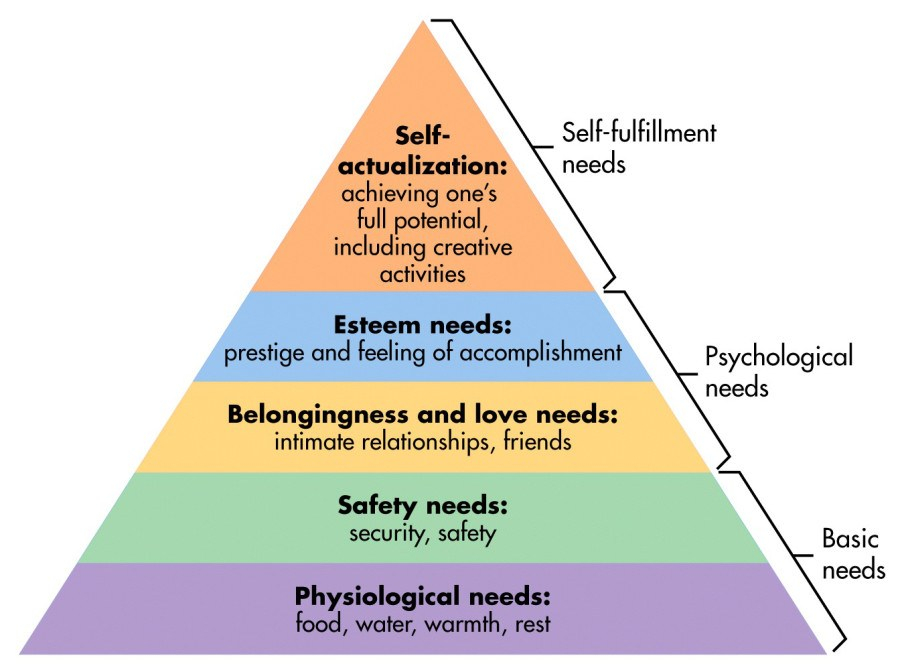
Belonging is our most basic need. Maslow’s hierarchy (McLeod, 2018) recognizes that a child needs to belong before they can move towards building self-confidence and self-actualization (Peterson & Taylor, 2009). maslow-5To feel that we belong, we must build relationships with others. Complex kinship systems have existed within First Nations communities for thousands of years (Learn Alberta, 2019). By building a sense of kinship within your classroom, you can ensure that students feel a sense of belonging, culturally socially and physically.


Weak Spirit of Belonging Distorted Spirit of Belonging

Spirit of Belonging

Distrust Overly Dependent Trust
Exclusion Cult Vulnerable Inclusion
Detachment Gang Loyalty Warmth
Rejection Craves Acceptance Friendship
Antagonism Craves Affection Cooperation

To build a sense of belonging, create physical spaces for all. The arrangement of the classroom should reflect the need to serve whole group, small group and individual work needs through:

  • Desk arrangements
  • How large furniture allow for student movement
  • If possible, have a quiet space for those who need it

Include all students in time to learn together. Have all students of different abilities, ethnicities and backgrounds working in the same classroom. They can cooperate, communicate and care for one another. By engaging in heterogeneous groupings frequently, students can know one another deeply. Assistive technologies can help to support students who have mild or severe disabilities and help them to contribute the learning of the whole.

Provide opportunities for students to know each other, such as an Interview and Share activity. Provide positive encouragement to try new activities and recognize individuality and creative talents.

Mastery: I may not be perfect at everything, but I will always try to get better.

Mastery is not only of the cognitive domain, but it is also a holistic view of learning that includes physical, social and spiritual competencies. Giving children the opportunity to develop all parts of self can help to grow a strong spirit of mastery.

Weak Spirit of Mastery

Distorted Spirit of Mastery

Spirit of Mastery

Failure Oriented Arrogant Successful
Unmotivated Workaholic Motivated
Non-Achiever Over Achiever Achiever
Avoids Risks Risk Seeker Creative
Fears Challenges Cheater Problem Solver

To build a sense of mastery, teach students using authentic, relevant, differentiated learning. This includes things such as low floor, high ceiling tasks, open-ended and parallel tasks, and being cognizant of multiple intelligences when planning instruction and assessment.

Using Outcomes-based assessment and tracking progress towards a set standard can help students and teachers know where learning is at and respond accordingly. Dylan Wiliam has identified that clarifying learning targets is key to improving achievement and mastery (2011). When the criteria for success is visible and understood, students can strive for it. Teaching students to set learning goals and solve problems through collaboration can help them to build a spirit of mastery. Communicate teacher expectations clearly and provide specific feedback on student behaviour.

Independence – Earning independence by building trust.

One of the goals of education is for students to own their own learning. Dylan Wiliam (2011) has identified that goal setting and strategies for students to direct their learning path and destination. It is important that if students are pulled out of the classroom for additional support, they understand that it is to help them become independent when they rejoin their classmates. Student empowerment is important to build intrinsic motivation and confidence to persist through learning experiences.

Weak Spirit of  Independence Distorted Spirit of Independence

Spirit of Independence

Impotent Manipulative Powerful
Coerced Dictatorial Assertive
Unassured Defies Authority Confident
Misled Rebellious Self-Control
Futility Reckless Optimism

Building a democratic classroom can occur through classroom meetings to make decisions, offering choices within curriculum, and co-constructing classroom rules and norms. This can be done through the Circle of Courage itself, with groups brainstorming what it looks like when we work together to build a sense of belonging, mastery, independence and generosity within our community of learners.

By teaching self-regulation, we encourage and build independence and self-control. This can assist students in maintaining focus and personal responsibility.

Generosity – Giving to others makes you feel good.

The virtue of generosity is one of the most valued within Indigenous communities. There is a responsibility to care for others within our community. By being generous, learners can develop a sense of pride and joy. Service projects and creating spaces that allow for generosity to occur can help to strengthen students’ spirit of generosity.

Weak Spirit of Generosity Distorted Spirit of Generosity

Spirit of Generosity

Emptiness Driven Purpose
Rancour Over Involvement Empathy
Exploiting Servitude Kindness
Vengeance Co-Dependent Forgiving
Disrespectful Plays Martyr Respectful

Citizenship education can help us to build a caring community within and outside of our classrooms. At the beginning of the school year, create opportunities for students to know each others’ stories. Activities such as collaborative writing, field trips together, assigned student jobs contributing to the well being of the class, and collaborative problem-solving activities can help students experience giving and receiving support. By watching slide shows of classmates completing tasks can all build a sense of care.

Introducing and teaching the Circle of Courage can help your students understand how they are building their own and their classmate’s resilience and spirit.

Brendtro, L., Brokenleg, M., & Van Bockern, S. (1990). Circle of Courage. Retrieved February 14, 2014, from Reclaiming youth international: http://www.reclaiming.com/content/aboutcircleofcourage

Circle of Courage Model – Spaces. (n.d.). Retrieved 05 15, 2019, from Portland Community College: https://spaces.pcc.edu/download/attachments/13337564/Circle+of+Courage+Model.doc

Learn Alberta. (2019). Kinship. Retrieved May 8, 2019, from Walking Together: First Nations, Metis and Inuit Perspectives in Curriculum: http://www.learnalberta.ca/content/aswt/kinship/

McLeod, S. (2018). Maslow’s Hierarchy of Needs. Retrieved May 5, 2019, from Simply Psychology: https://www.simplypsychology.org/maslow.html

Peterson, J. M., & Taylor, P. D. (2009). Whole Schooling and the Circle of Courage. Retrieved May 8, 2019, from Whole Schooling Consortium: http://www.wholeschooling.net/

Comprehension Across Subjects

Comprehension strategies are ways in which we make meaning of the information we take in through text, media, and sound. Often considered the domain of the English Language Arts teacher, we now realize that it is important that teachers across subject areas and grades encourage meaning making and use tactics that cause learners to use strategies that they may or may not be fluent in.

Depending on which researcher you follow, you may categorize comprehension strategies into 6, 7, or even 13 different strategies. Following the framework of Ellin Keene (1997) in her book Mosaic of Thought: Teaching Comprehension in a Readers Workshop, this post identifies seven strategies that help learners make meaning of complex information. A detailed comprehension strategies summary describes the actions of readers, writers, mathematicians, and researchers.

comprehension dog
Photo by Jesse757 – Creative Commons Attribution License  https://www.flickr.com/photos/7721141@N07

While categorizing strategies and tactics is helpful, we need to keep in mind that the comprehension strategies are all interconnected. Visualization is grounded on activating and connecting knowledge. Determining importance and summarizing are closely related. Monitoring comprehension often creates self-questions. Each person has different comprehension strategies that their mind tends to use. Our challenge as teachers is to create a pause and opportunity for students to try stretching to new mental pathways.

Activating and Connecting Prior Knowledge

This comprehension strategy involves students connecting their learning to past experiences, events in the world, and to other learning they may have in and out of school. We simply can’t understand new information that we hear, read or view without thinking about what we already know. It is important that teachers teach learners to:

  • Relate to prior experience.
  • Make connections between text, media, and personal observation.
  • Connect the new to the known – use what learners know to understand new information.

visual dictionary - activating and connectingWhen students are using this comprehension strategy, you may hear them say…
  • This reminds me of…
  • I noticed…
  • It made me think of…
  • I never knew…
  • That changed my mind…
  • This is different from…

Some tactics that teachers might use to promote activating and connecting prior knowledge include:

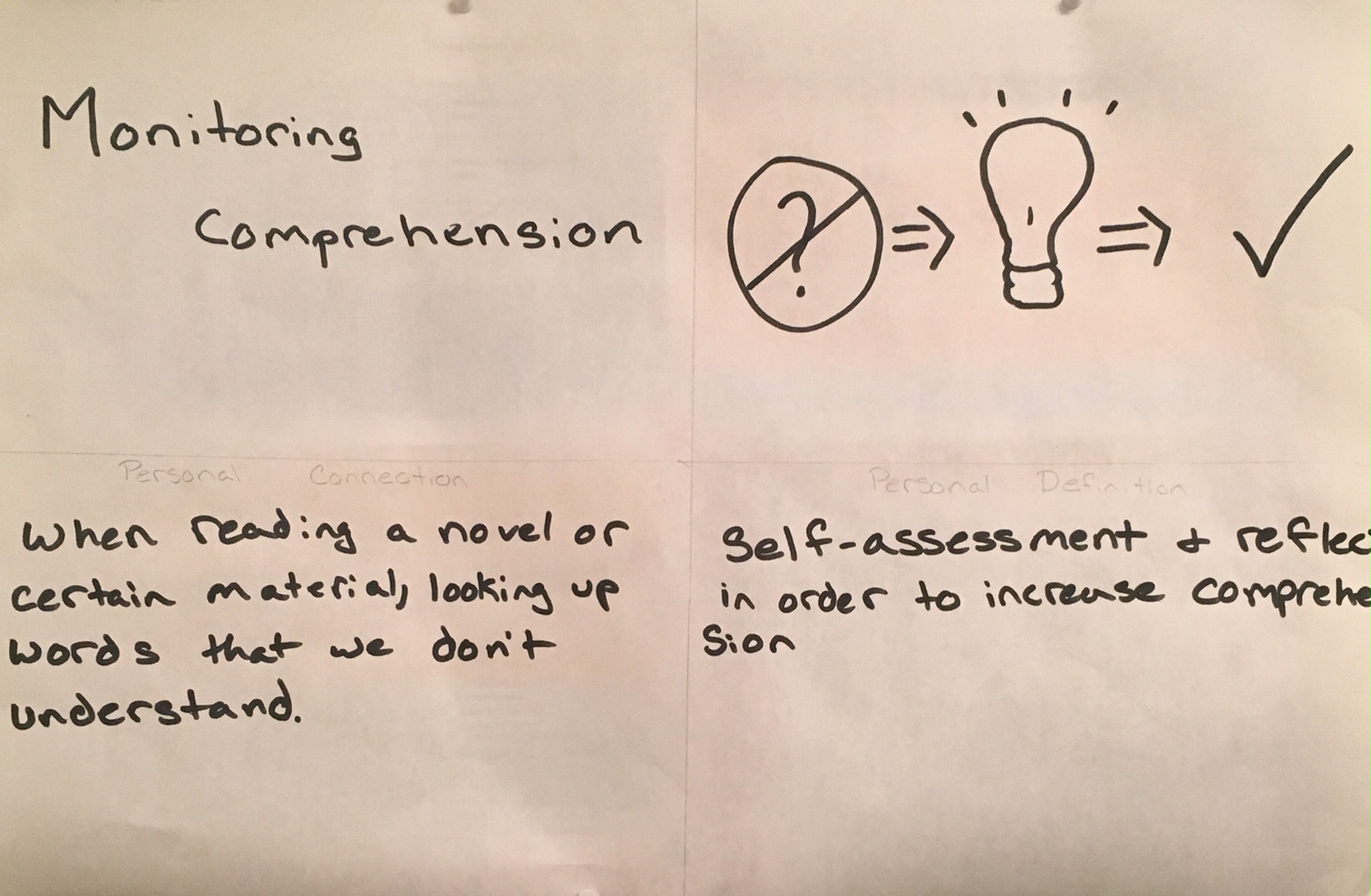
Monitoring Comprehension

This comprehension strategy involves students recognizing and acting on their own confusion, and their self-questioning to determine understanding. We monitor our comprehension and keep track of our thinking in a number of ways. We notice when text makes sense and when it doesn’t. We ask questions, infer, activate background knowledge, and make connections, all in the effort to promote understanding. It is important that teachers teach learners to:

  • Become aware of their thinking as they read.
  • Notice when meaning breaks down and their mind wanders.
  • Employ ‘fix up’ strategies – reread for clarification, read ahead to construct meaning, use context to break down unfamiliar words, skip difficult parts and continue to see if meaning becomes clear, check and recheck answers and thinking, and examine the evidence.

visual dictionary - monitoring comprehensionWhen students are using this comprehension strategy, you may hear them say…
  • I think…
  • I understand…
  • This doesn’t make sense…
  • Oh, now I get it…
  • A part I had trouble with…

Some tactics that teachers might use to promote monitoring comprehension include:

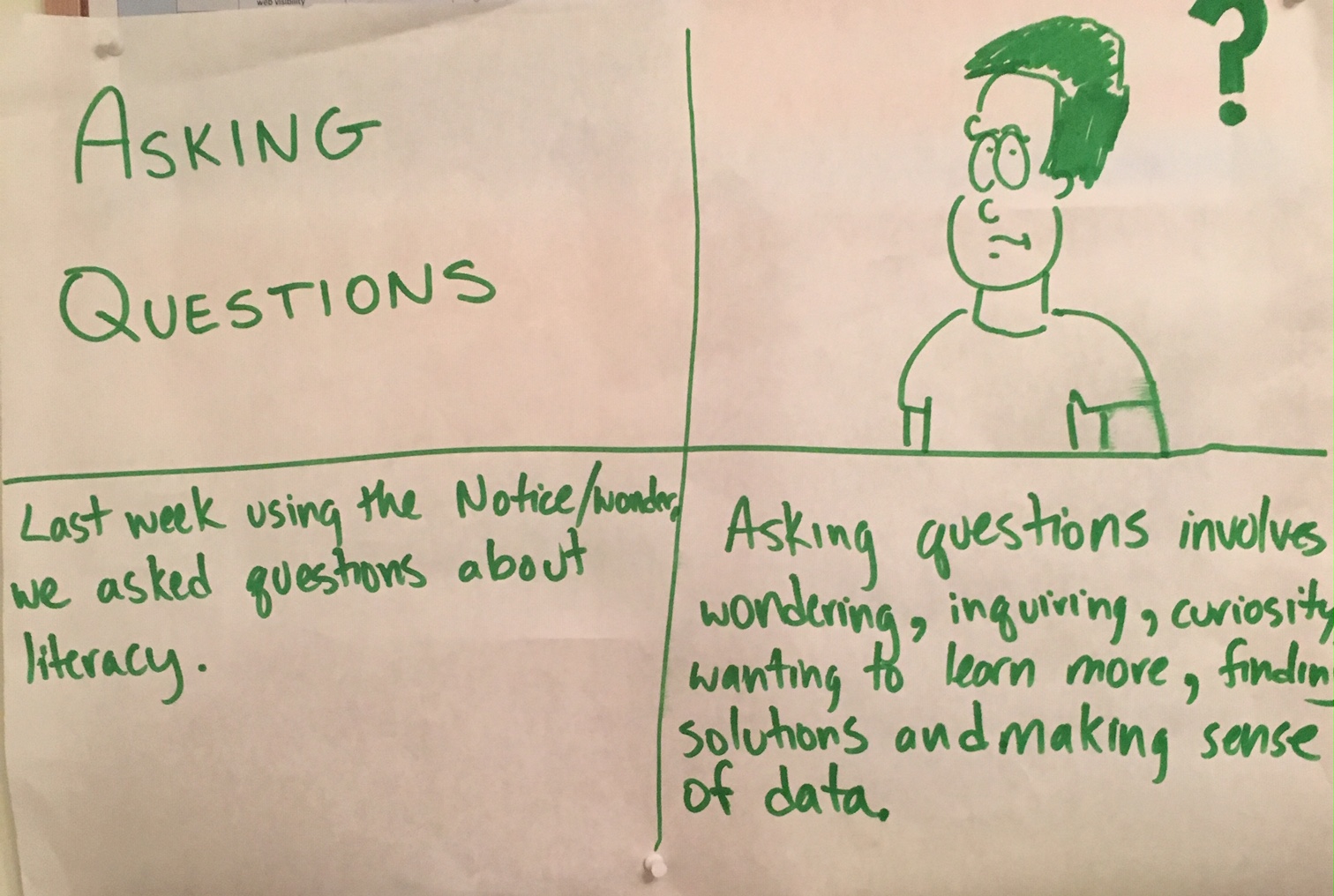
Asking Questions

This strategy involves students actively wondering about topics and questioning facts and information. Questioning is the strategy that propels learners on and is at the heart of inquiry-based learning. Humans are driven to make sense of the world, and questions open the doors to understanding. It is important that teachers teach learners to:

  • Wonder about the content, concepts, outcomes, and genre of text.
  • Question the author.
  • Read to discover answers and gain information.

visual dictionary - asking questionsWhen students use this comprehension strategy, you may hear them say…

  • I wonder…
  • I’m curious…
  • My big question is…
  • Why…
  • Do you know anything about…

Some tactics that teachers might use to promote questioning include:

Making Inferences

This comprehension strategy involves students predicting, hypothesizing, interpreting, and making conclusions. Inferential thinking allows learners to grasp the deeper essence of text and information. Readers infer by taking their background knowledge and merge it with clues int he text to draw a conclusion or arrive at a big idea that is not explicitly stated in the text. It is important that teachers teach learners to:

  • Use context clues to figure out meaning of unfamiliar words.
  • Draw conclusions from evidence.
  • Predict outcomes, events and observations.

visual dictionary - making inferencesWhen students use this comprehension strategy, you may hear them say…
  • I’m thinking…
  • It seems to me…
  • I’m guessing that…
  • I predict…
  • Probably…

Some tactics that teachers might use to promote inferring include:

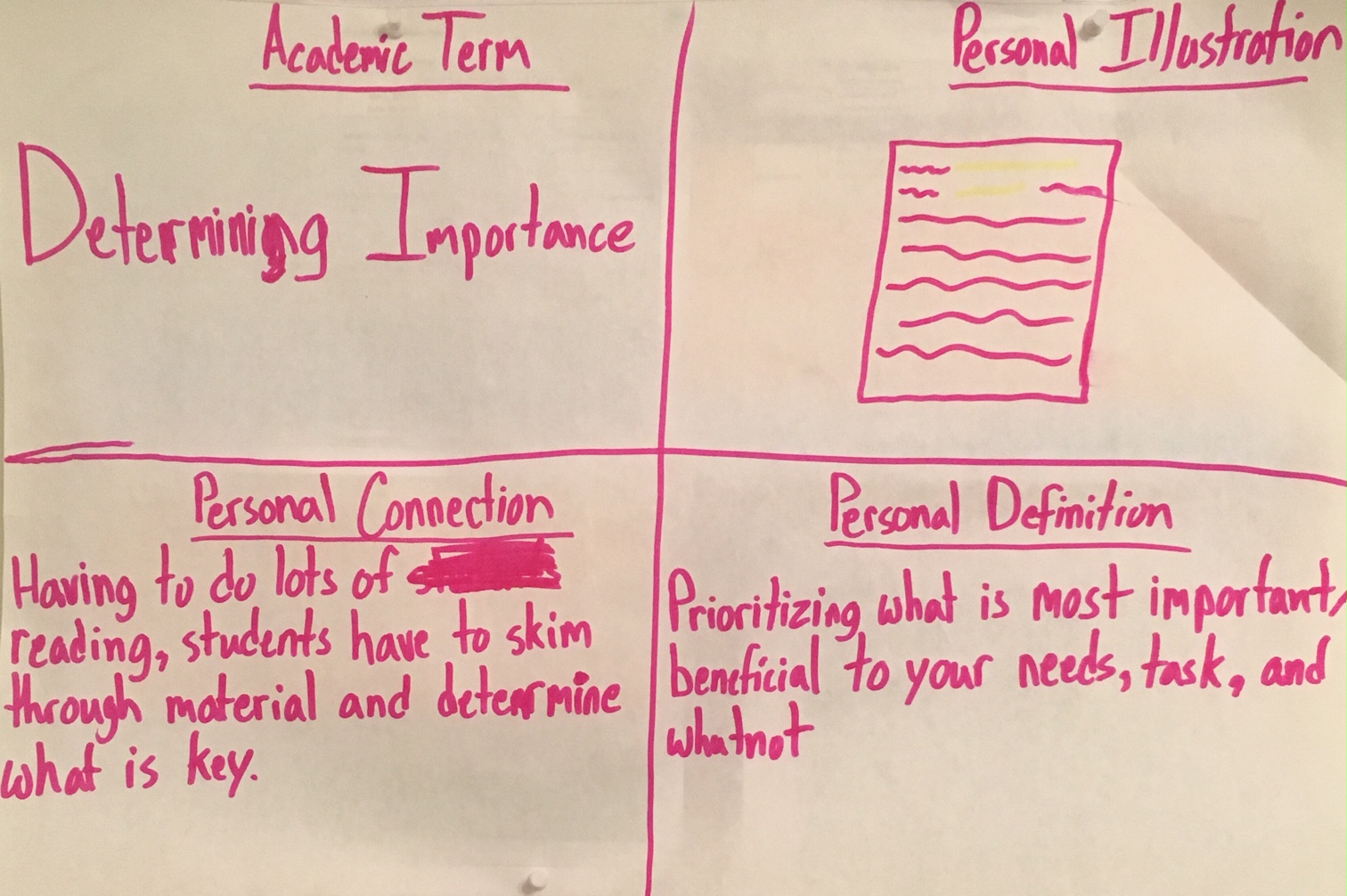
Determining Importance

This comprehension strategy involves students evaluating information, making judgments about information, and identifying key ideas and concepts. We read nonfiction to learn, understand, and remember information. It is important that teachers teach learners to:

  • Target key information.
  • Choose what to remember.
  • Construct big ideas from smaller ideas.

visual dictionary - determining importanceWhen students use this comprehension strategy, you may hear them say…
  • This is really important…
  • The most important ideas here are…
  • So far, I have learned that…
  • I think this part means…

Some tactics that teachers might use to promote determining importance include:

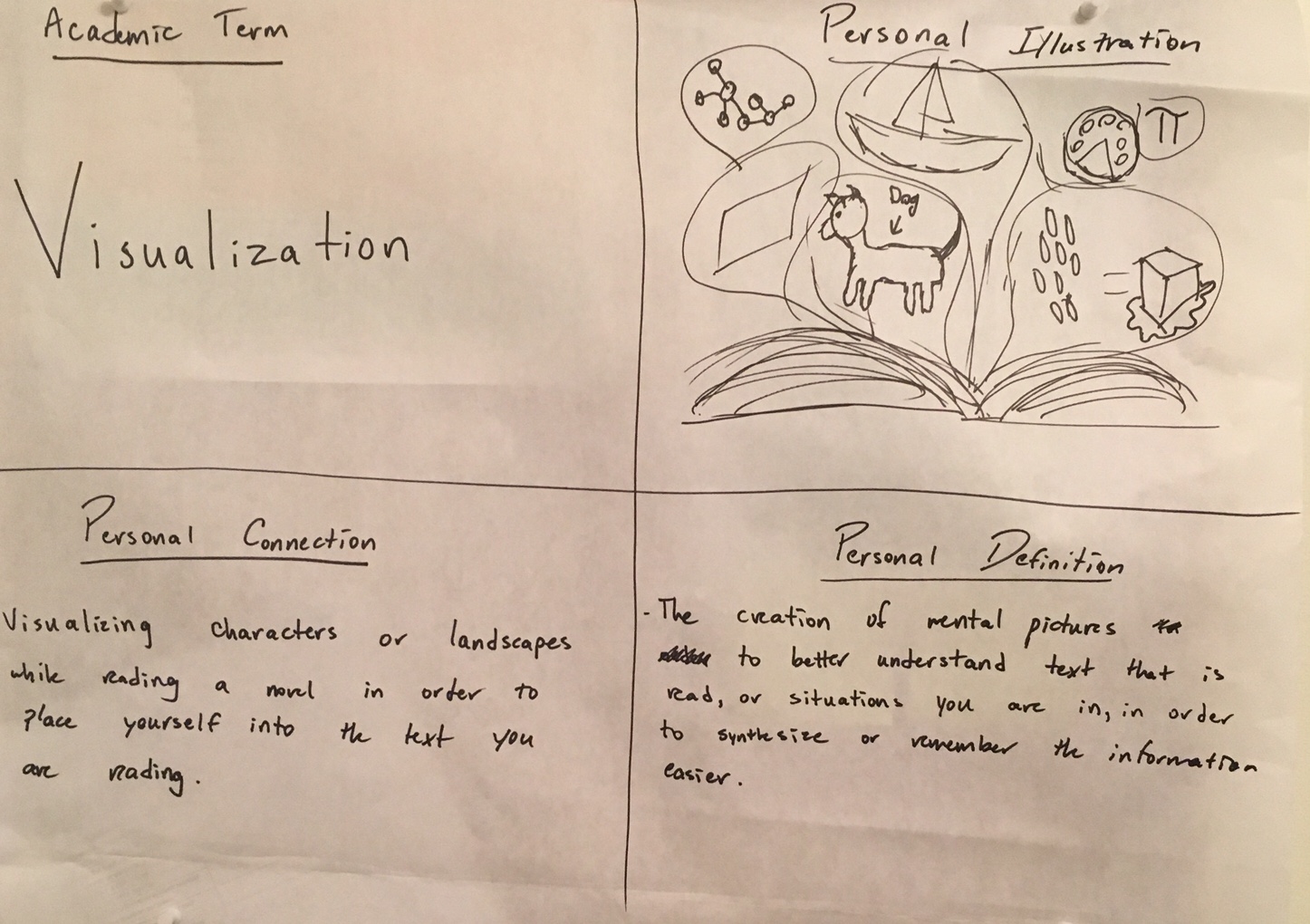
Visualizing

This comprehension strategy involves students making mental pictures and/or mind maps of ideas and how they interconnect. Visualization builds complex connections and involves more than just how something looks. It extends to other senses such as smell, touch, sound, and taste. It is important that teachers teach learners to:

  • Gain information from the images they construct and view.
  • Create mental images drawn from background knowledge and observations.

visual dictionary - visualizationWhen students use this comprehension strategy, you may hear them say…

  • I am getting a picture…
  • I can see (smell, hear, taste)…
  • I have a picture in my head…

Some tactics that teachers might use to promote visualization include:

Summarizing and Synthesizing

This comprehension strategy involves students recalling, retelling, creating new meaning, and remembering information. Synthesizing information allows us to see the bigger picture as we read or observe. Thoughtful readers merge their thinking with information to come to a more complete understanding. It is important that teachers teach learners to:

  • Add to their knowledge base.
  • Paraphrase information
  • Move from facts to ideas.

Summarizing and synthesizing are often used as synonyms. While they are related, they are different strategies that readers use. Sarah Eaton, a professor at the University of Calgary (2010, Summarizing vs Synthesizing), identifies these differences:

SummarizingSynthesizing
A basic reading technique.An advanced reading technique.
Pulls together information in order to highlight the important points.Pulls together information not only to highlight the important points, but also to draw your own conclusions.
Re-iterates the information.Combines and contrasts information from different sources.
Shows what the original authors wrote.Not only reflects your knowledge about what the original authors wrote, but also creates something new out of two or more pieces of writing.
Addresses one set of information (e.g. article, chapter, document) at a time. Each source remains distinct.Combines parts and elements from a variety of sources into one unified entity.
Presents a cursory overview.Focuses on both main ideas and details.
Demonstrates an understanding of the overall meaning.Achieves new insight.

Summarizing is taking the details of information apart while synthesizing is putting those details back together into a new and unique whole.

visual dictionary - summarizing and synthesizingWhen students use this comprehension strategy, you may hear them say…

  • I never knew… now I know…
  • I think the big idea is…
  • I have learned that…
  • Now I understand that…

Some tactics that teachers might use to promote summarizing and synthesizing include:

When do we explicitly use Comprehension Strategy Tactics?

If the information that we are having students interact with is complex, it is important to use instructional methods that help them make meaning. As well, if we notice that students are struggling with a specific skill or content area, we can view comprehension strategy instruction a possible solution to those learning barriers. Teaching with comprehension in mind will lead to increased cognitive engagement and deeper meaning-making.

Eaton, S. E. (2010, September 26). Reading Strategy: The difference between summarizing and synthesizing. Retrieved from http://www.drsaraheaton.wordpress.com

Johanson, T., & Broughton, D. (2014). Exploring Comprehension in Physics. Saskatoon: McDowell Foundation.

Keene, E., & Zimmermann, S. (1997). Mosaic of Thought: Teaching Comprehension in a Readers Workshop. Portsmouth: Heinemann.

Public Education & Business Coalition. (n.d.). Thinking Strategies for Learners: A guide to PEBC’s professional development in reading, writing, mathematics and information literacy. Retrieved December 15, 2018, from Public Education & Business Coalition: https://www.pebc.org/wp-content/uploads/publications/thinking-strategies.pdf

Saskatchewan Ministry of Education. (2008). English Language Arts 6. Retrieved from Saskatchewan Curriculum: https://www.curriculum.gov.sk.ca/bbcswebdav/library/curricula/English/English_Language_Arts/English_Language_Arts_6_2008.pdf

Routines, Puzzles and Games for Math Fluency

Math fluency is the ability to perform mathematical operations quickly and accurately. Math automaticity with basic facts is part of fluency. John Munroe (2011)  indicates that we as learners have a finite amount of working memory. It is important that student working memory is available to learn new math concepts, solve complex problems and think creatively in mathematics, rather than being used to recall basic math facts.

So, how do we promote automaticity of basic math facts without endless worksheets, mad minutes and text-book assignments? Math games, puzzles and routines related to grade level concepts allow for flexibility in thinking, practice and student engagement and fun. The following documents can help us connect practice with curricula:

Math Routines

There has been a significant amount of research in the area of mathematics routines to enhance learning, building automaticity and fluency. There are a number of key resources that are helpful to teachers from grades 1 to 10.

Routines Resources.PNG

Productive Mathematics Discussion

Margaret Smith (2011) has created a structure for planning for and implementing classroom discussion in a mathematics classroom. Discussion and sharing mathematical thinking is the key to most mathematics routines.

Math Discussion

This sequence of thinking can be applied to a teaching strategy, Learner Generated Examples (Crawley, 2010), to create a powerful way of sharing student thinking in mathematics.

Learner Generated Examples:

Brian Crawley, a teacher from Saskatchewan, did extensive research on learner-generated examples. Overlaying the Five Practices, you create a cycle that can be applied to many number routines:

Learner Generated Examples

Move through this cycle three times. This allows students to push beyond the knowledge that they find easy to access and move to more and more complex ideas.

Examples of Math Routines

There are several powerful math routines gathered from many Math Routine Resources that can be adapted to different concepts over grade levels. The following is a short list:

The key to math routines influencing math fluency in your classroom is to choose appropriate concepts and numbers related to your curriculum. For example, in the routine “Today’s Number”, if you are in early primary, you might choose a number between 1 and 10. If you are teaching ideas around skip counting, perhaps choosing the number 6. If you are working on perfect squares, perhaps choosing a number like 36.

Math Puzzles

Math puzzles allow learners to explore mathematical ideas and practice thinking flexibly. Well-designed puzzles are engaging and logical, with most of the time focussing on solving the puzzle mathematically. As with routines, puzzles can be adapted to the range of numbers and concepts appropriate for a given grade level.

Missing Number Puzzles

Kakooma

  • Examples and explanation are found on Greg Tang’s Kakooma Resources website
  • Kakooma helps students build automaticity with addition and multiplication.
  • There are a variety of number puzzles, with a diverse range of numbers and volume of questions to solve.

Math Squares

Two-Ways

Mazes

Inaba Place Value Puzzles

Math Games

When choosing and setting up games in your classroom, along with considering the math concepts you are emphasizing, it is also important to consider student grouping and classroom norms.

By creating homogeneous groupings, it is possible that some groups will use tools to help them calculate or identify numbers, such as:

In heterogeneous math game groupings, it potentially frustrating for both the stronger student and student who needs more time to compute or recall math facts.

There are many excellent math games sites that include Math online games. As well, there are many games that require few materials and are engaging for students.

Of special note are Alphashapes and Alphashapes Games that can be played to understand mathematics language.

The key to finding and using math games in your classroom is to know the math that you would like to build fluency in, and then search for those concepts. There are literally thousands of great sites that you can access both online and paper copy games.


Blog at WordPress.com.

Up ↑