As math teachers, we spend much of our time planning for students who need extra time or support to understand mathematics at our grade level. We also worry about how we might create appropriate challenge for students who have a strong foundation in math and are ready to move ahead before their classmates are ready. The last thing we want is for our most able mathematics students to get bored and disengage. Enrichment seems like a good option, but how do we do that?
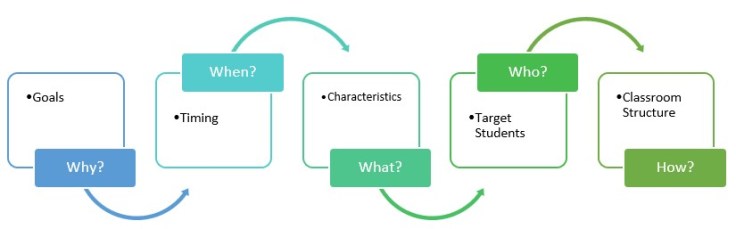
Why? Goals
Enrichment activies are meant to allow students to
engage in rich tasks and activities at grade level
stay with their peers
replace foundational math tasks that other students require to build understanding
reinforce mathematical thinking skills so that students are even more able to engage in grade-level math
When? Timing
There are at least two opportunities for enrichment within your instructional sequence.
When we pause to help students review and build readiness for grade-level instruction. This might be in the form of a concept review, reteach, or responsive station.
Enrichment tasks can be an option for students who do not need to review or practice foundational skills.
Enrichment tasks that are loosely based on the same concepts as are in the review will help students be even more ready for grade-level instruction.
When we are teaching grade-level concepts and the majority of students require more time to complete tasks.
Enrichment tasks can be an option for students who are done work earlier than their peers.
Enrichment tasks that are loosely based on the grade-level concept, but allow for creative thinking and application can allow students to see mathematics in a creative and contextual way.
What? Characteristics
Enrichment tasks take on all different forms. Some common characteristics might be:
Engaging
Hands-on
Applied to the Real World
Creative
Games
Puzzles
Math Outside of Curriculum
Connecting Math Concepts
Social Justice topics
You can access hundreds of curated resources in this Enrichment Task Google Folder. Feel free to share, download, and use these resources.
Who? Target Students
All students might be able to engage in Enrichment tasks at some point in the year. Different students have different strengths. Enrichment is not exclusive to gifted students.
How? Classroom Structures
A station or enrichment corner are relatively simple to set up. One thing to consider is what tasks to have available at what time. A suggestion is that the tasks in the enrichment station should be loosely related to the math concept being experienced by the rest of the class. This ensures that the students doing enrichment tasks are going to be even more able to complete grade-level math tasks. When enrichment tasks are completely unrelated to the math students will experience next, we are inadvertently creating a time gap in student learning and may actually contribute to lower achievement.
Our school year seems to race by faster and faster every year. A worry that we have is that our students might not be ready for their next concept, next grade, or next step in their education journey. Some of our hopes while year planning would be to:
Prioritize concepts that are foundational to the next school year.
Estimate time so that higher priority outcomes have more time.
Order concepts logically so that math ideas build within a grade.
Cluster outcomes that help kids understand the connections between math ideas.
A prioritized and sequenced math year plan is not a pacing guide. Rather, it is a roadmap that helps you, as teacher, know where you are going next, and provides an estimate for how long to spend on a concept. A prioritized and sequenced year plan should be revisited several times through the year to see where you are at, what might need to change, and what your students need next.
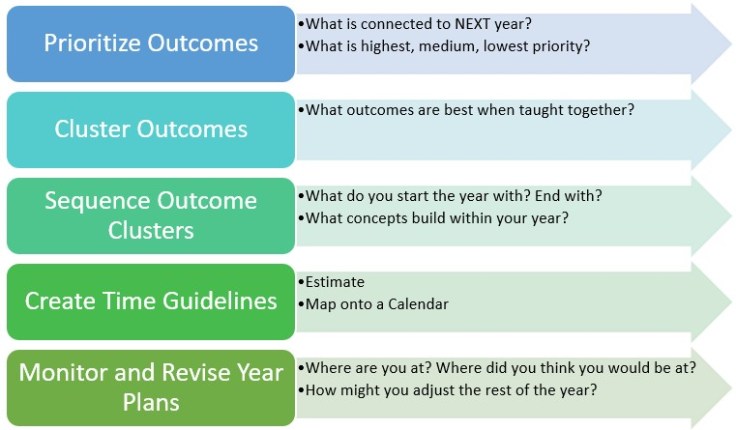
Creating a Prioritized and Sequenced Math Year Plan
Prioritize Outcomes
To prioritize outcomes in our grade level, it is important to know what concepts lead directly into next year’s math curriculum. Some tools that help you do this are Curricular Through Lines. It is most helpful to use the document that shows YOUR grade as well as the grade level after you:
Highlight outcomes YELLOW if they lead directly into next year. For example, multiples and factors in Grade 6 (N6.2) leads directly into adding and subtracting fractions (N7.5) and divisbility rules (N7.1).
Do not highlight an outcome if it does not lead directly into next year. For example, numbers greater than 1000000 in Grade 6 (N6.1) does not lead into any outcome in Grade 7.
Go back to your yellow outcomes. In a given year, you might want to have 6-7 outcomes that are highest priority (GREEN). If you have more than 6-7 outcomes highlighted yellow, which of those would be most important to emphasize? You might want to have a discussion with the next grade teacher to help you determine this.
At the end of this process, you might have:
6-7 HIGHEST priority outcomes.
some MEDIUM priority outcomes.
some LOWEST priority outcomes.
Cluster Outcomes
Some of our curricula have several outcomes that would be much more effective if they are taught together. For example, in Grade 7, there are several patterns and relations outcomes and a shape and space outcome that are easier to teach if you put them together:
P7.1 – Relationships between tables of values, graphs, and linear relations
P7.2 – Understanding equations and expressions
P7.3 – Solving one and two step equations with whole numbers
P7.4 – Solving one and two step equations with integers
SS7.4 – Ordered pairs and the Cartesian Plane
When you look at these holistically, it might make sense to cluster these outcomes into:
P7.3 and P7.4 – Solving one and two step equations
P7.1, P7.2, SS7.4 – Representing linear equations as a graph, table of values, equations, words, and pictures/manipulatives.
Once you cluster your outcomes in this way, they act as a single unit within your year plan.
Sequence Outcome Clusters
There are several things to consider when you are creating your outcome sequence:
How might you start the school year? What are they ready for after summer break?
If you follow the order of curriculum, we would begin with place value. While this might be logical at early grades, it can sometimes be daunting for students coming back after summer.
Consider starting with a topic that has lots of hands-on opportunities that can help students understand what numbers and shapes are. This will help get them ready for place value later on.
Example: Consider starting with a graphing and data outcome so that students can use numbers as they create axes for graphs and explore how big those numbers are within a real-life context.
What outcomes are pre-skills for other outcomes in your grade?
There are several examples where one outcome logically comes before another one.
Example: In grade 2, it makes sense that numbers to 100 would be taught before adding and subtracting numbers to 100.
Sometimes we might think something is a preskill that is not. For example, in grade 3 we might think that we need to do addition and subtraction before we do multiplication and division. Because multiplication in grade 3 is limited to 5 x 5, we don’t need to be able to add large numbers before we multiply. In fact, the pre-skills for multiplication are:
knowing numbers to 25.
skip counting by 2, 5.
decomposing numbers.
How might you end the school year? What is best suited for May and June instruction?
Spring is a great time to go outside and extend your classroom. When you consider what math fits into outdoor experiences, you might want to plan for those concepts in the spring.
Example: Grade 3 data and graphing could be based on finding things in the natural environment, creating concrete graphs, pictographs, tallies, and graphs representing what you find.
Create Time Guidelines
The time you spend on each topic is determined mostly by how many highest priority outcomes or outcome clusters you have identified and how many days of mathematics you have in a school year. If you have math every day, you can count on having approximately 150 days of math, as there are always concerts, field trips, and other things that impact instructional time.
Estimate the amount of time per outcome (or outcome cluster):
Highest Priority Outcome – 22 to 25 days
Lowest Priority Outcome – 2 to 5 days
Medium Priority Outcome – 5 to 10 days
Estimate the total number of days you might need for all of your prioritized outcomes.
Is this approximately equal to your instructional time?
Do you need to shorten timelines? Lengthen them?
Plot your units out onto a school year calendar.
Do outcomes begin and end at logical times? What might need to shift for holidays and report cards?
Sample Year Plans
Sample year plans are not meant to show you a ‘right’ answer, but rather to be an example of what a prioritized and sequenced year plan might look like.
It is important to revisit and revise your year plan through the year. Student needs and unexpected disruptions require adjusting along the way. Things to consider when you are reflecting on your year plan are:
Where did I think we would be in our sequence right now? Where are we actually at?
When I look ahead to the end of the year, do I need to adjust the amount of time I am spending on the units I have left?
Are there some of my prioritized outcomes that I need to deprioritize to give us time on what is MOST important?
Might I need to shift some of my lower and medium priority outcomes to stations or centers?
Are there some outcomes that I might connect to other curricula? Examples include:
Some shape and space outcomes moved to Art (transformations, area, 3D objects)
Some statistics outcomes moved to Social Studies (measures of central tendency, graphing)
It is important to keep your year plan current so that can make informed decisions throughout your year. Reflecting regularly can help you build a strong foundation for your students.
How often have we been in a conversation with a colleague about trying to meet the needs of all of our students, and we hear the dreaded phrase “well, just differentiate”… this blanket statement can bring about visions of creating 18 different lesson plans for our 18 students. This is not sustainable, so what is differentiation REALLY? How do we meet the needs of diverse learners and keep our sanity?
Workshops focussing on differentiation are, ironically, often not differentiated. It is important that all professional learning, including those experiences based on the topic of differentiation, attempt to have teachers experience differentiated learning as well as reinforce the foundations of how and why we differentiate content, process, product and environment for students.
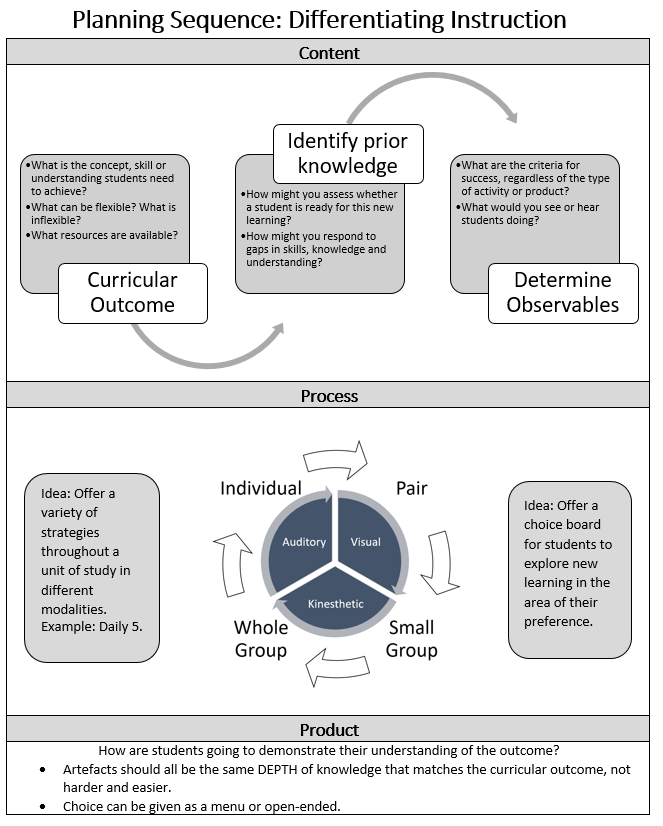
Planning for Differentiation
It is important to understand not only specific strategies but to also know why we might differentiate. What information do we need as teachers in order to plan appropriately for our individual students as well as our whole class experiences? We need to know a combination of Learning Styles, Multiple Intelligences, content readiness, and student interests in order to Plan for Differentiation.
Something that is often an ‘aha’ for adults is to consider whether they are “Think to Talk or Talk to Think” learners. If someone is a think-to-talker and is forced to jump into group work without first having the chance to get their thoughts in order, they may have a feeling of being unsafe expressing their ideas. If a talk-to-thinker is forced to read quietly before they are allowed to talk, they may find that their minds wander and are unable to focus. This same sense of safety is true for student learners as well.
One of the foundational researchers in the area of differentiation is Carol Tomlinson, who describes differentiation as
Being curious about our students,
Having relationships between teachers and students; and
Providing a variety of learning experiences to learners
Differentiating Content
Why:
Differentiating content allows you to address gaps in understanding to build readiness. We know in literacy that activating prior knowledge is essential for students to make connections to new learning. This is true in other subjects as well. Assessing prior knowledge allows gaps to be addressed before new concepts are introduced. Differentiating content allows students to ACCESS information and learning.
What:
Your curriculum drives the knowledge, concepts, skills, and understandings a student needs to know and use. While the curricular outcome cannot change for individual students, the delivery format for content such as video, readings, audio, reading level can be differentiated. Content can also be chunked, shared through visual graphic organizers, or addressed through jigsaws to reduce the volume of information each individual needs to interact with. Themes can be based on personal interest to increase interest and understanding if a specific topic is not required by the curriculum.
How:
Use pre-assessment to determine where students need to begin, then match students with appropriate activities. Pre-assessments may include:
Student/teacher discussion,
Begin a KWL chart – what we know/want to know/learned,
Journal – what you already know about,
Brain dump – list all of the things you know about a topic, cluster with other class members, and
Snowball.
Use texts or novels at more than one reading level.
Present information through both whole-to-part and part-to-whole.
Use a variety of reading-buddy arrangements to support and challenge students when working with different texts.
Re-teach students pre-skills or provide enrichment for students who already demonstrate an understanding of pre-skills.
Use texts, video or different media to convey information.
Use Bloom’s taxonomy or Webb’s depth of knowledge to encourage thinking about content at several levels.
Differentiation Process
Why:
Differentiating process is about how students make sense of new learning. What is happening in each individual brain is based on their learning preferences, multiple intelligences, and background. Learners need time to take in, reflect on and make sense of new learning before moving on. Processes help students monitor their comprehension and determine what they do and do not understand. Learning processes also allow teachers to formatively assess student progress and provide feedback in real time.
What:
There are many different words used to describe learning processes – instructional strategies, discursive strategies, comprehension strategies… all of these are ways that learners interact with and make sense of new learning. Providing more or less structured support for learning, planning for a variety of instructional strategies based on the variety of learning styles in a classroom during a unit of study, and providing opportunities for self-reflection and self-assessment, and providing individual, pair/small group and whole group learning experiences are some key ideas for differentiation process.
How:
Assess learning styles, multiple intelligences, learning preferences, etc. to understand individual learning profiles as well as your class profile.
Use tiered activities that allow all students to work on the same outcome but with different levels of support.
Provide different learning experiences based on interests – i.e. when exploring mixtures and solutions, some students might choose to learn concepts through cooking, while others may learn concepts through art.
When planning a unit of study, ensure that concepts are interacted with using a variety of modes. For example, in mathematics, a planning form for math could be based on the idea of multiple representations of mathematical ideas:
Use a variety of comprehension strategy tactics.
Provide choice for students for how they are going to take notes, summarize information, make connections.
Literature Circles(which also support content and product differentiation).
Different classroom structures, such as stations/centers, choice boards, flexible grouping all allow for different processes to be occurring simultaneously.
Differentiating Product
Why:
Differentiating product allows for student choice and allows learners to use their strengths to represent their understanding. Product choices all align to curricular outcomes, so learning is not compromised. Student voice and choice increase learner engagement. Products are the way that students represent their thinking about a curricular outcome. Differentiating the type of product being created allows you to see what they know about the curricular topic rather than the skill they needed to package that representation.
What:
Product differentiation is often cited as the most common form of differentiation and is often in the form of choices. You as the teacher may provide those choices and students pick from a variety of formats, you may have students propose their own designs or a combination of the two. How much responsibility and autonomy you provide for your students will depend on factors such as student understanding of their own strengths, age and time. When providing choice, it is important to co-construct clear criteria for success so that all products, regardless of form, are all being assessed on curricular outcomes rather than the form of a product. A rule of thumb is that the same checklist/rubric/assessment tool should be able to be used for all products on the same outcome, whether they are a paper, video, play, board game, etc.
How:
Allow students to help design product choices.
Co-construct assessment criteria.
Allow for varied working arrangements – individual, pair, group
Provide for or encourage students accessing a variety of resources.
Use a common assessment tool (checklist, rubric, etc.).
Conclusion:
When teachers plan by connecting content, process, product and learning product with student readiness, interests and learning profiles, students are more engaged and are able to understand ideas with a higher level of complexity.
Our conversations in mathematics teaching are often centered
around the gaps that we observe in student understanding, or how students are
not ready to learn the grade level mathematics that we are trying to teach
them. When we look at our teaching practices in other subjects, we know that it
is important to Activate and Connect Prior Knowledge, and to provide responsive
instruction if there are skills that our students are missing. The same holds
true in mathematics, but how do we do this in a structured, systematic and
efficient way in our classrooms? The Assess-Respond-Instruct framework, developed
with and implemented by teachers from across Saskatchewan, does exactly that.
Foundationally, the Assess-Respond-Instruct framework
provides opportunities for
teachers and students to know whether students
have an understanding and fluency with prior knowledge, and
filling gaps in knowledge and build fluency, and
engage in grade level mathematics.
In order to embark on this way of teaching, some key questions that drive our planning are:
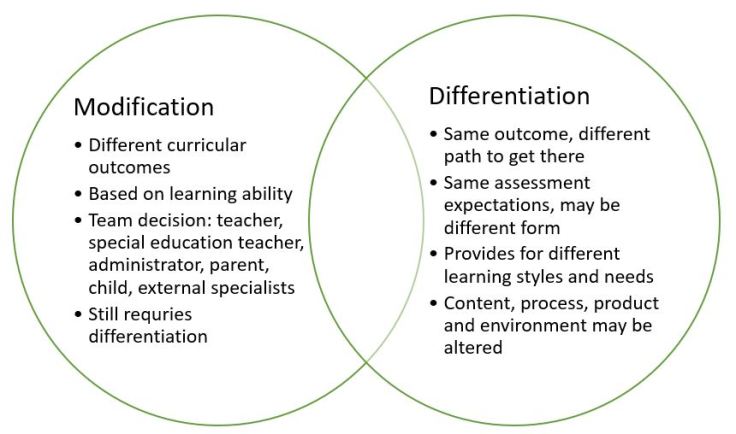
Differentiation vs Modification
A key idea within mathematics is the difference and similarity between differentiation and modification. Working with a school last week, we brainstormed the following key ideas:
Sometimes, a student needs a modified curriculum because
they are unable to grasp mathematical concepts. This determination is made with
much consultation with the education team, parents, and students. Communication
is key between home and school to ensure that parents understand that their
child is not working towards grade level outcomes. Rather, they are on a
modified curriculum with modified assessment expectations. When a child is
working towards a modified curriculum, it should still be differentiated.
Students need to experience a variety of modes and strategies to help them
achieve their unique learning goals.
The difficulty is when a student or class is inadvertently
experiencing a modified curriculum without the pre-thinking and opportunities
to engage in grade level mathematics. This might look like a child being
identified as ‘not being able’ to add and subtract in grade 4, so they only
work on addition and subtraction when their classmates are working towards
multiplication and division. In this example, the child is not given an
opportunity to engage in grade level outcomes, so the gap in their learning is
even larger the following year.
So what is a possible solution? The Assess-Respond-Instruct Framework!
Designing Pre-Assessments
Pre-assessments should focus on mathematics knowledge that
students need in order to be ready to engage in new, grade-level instruction.
Content to Pre-assess
We can identify the pre-skills necessary for a new unit of
study by mapping curriculum and asking ourselves “What might students know before
this grade to help them understand the content at our grade level?”
P6.1 – Extend understanding of patterns and relations in tables of values and graphs.
P6.2 – Extend understanding of preservation of equality concretely, pictorially, physically, and symbolically.
P6.3 – Extend understanding of patterns and relationships by using expressions and equations involving variables.
In this Grade 6 Saskatchewan example, the blue concepts are grade-level, while the yellow concepts are mathematical ideas that appear in curriculum before Grade 6. By mapping curriculum, you can see that new, grade-level instruction is only one small step beyond what students have experienced in the past.
Analyzing the pre-skills from the example above, we can see that they can be clustered in the following way:
It is important to identify the extent to which students might need to understand a concept. In this Grade 6 example, students need to understand and be fluent in addition with single digit numbers, and subtraction of double digit minus single digit numbers. We would not usually expect students to work with larger numbers when we are solving algebraic equations at this grade level. Even though curriculum has students learn and practice addition and subtraction to 10,000 in Grade 5, we do not need students to use these large numbers in THIS unit of study, so we would not pre-assess or respond to those large numbers.
The content of a pre-assessment for this example unit of study
would include:
Addition of single digit numbers and subtraction
of numbers no larger than 100.
Multiplication of single digit numbers and
division of numbers no larger than 100.
Representing relations, including tables of
values and graphs.
Solving one step equations, including balance scale
representations and missing value equations.
Forms of Pre-assessments
You might have assessment data that you have gathered through school-system pre-assessments, through tools like Pearson’s Numeracy Nets, or you can develop your own simple Pre-assessments.
How might we respond to gaps in pre-skills?
We need to consider both the content and structure that we
are using to respond to gaps in understanding. Many teaching innovations focus
on one or the other. I would suggest that we need to consider both the content
of intervention as well as the process, or structure, that we use to have
students interact with that content.
What is Responsive Content? Differentiating Mathematics Intervention
Too often, our mathematics intervention in upper grades
involves symbolic practice of a topic that a student is unsure of. Rather than
only focussing on symbolic practice, we need to differentiate our intervention
– additional practice worksheets are not enough if a student does not
understand.
What does differentiation look like in mathematics? If we consider NCTM’s ways of representing algebraic ideas, and the Theory of Multiple Intelligences, a simple way to look at differentiation for every math concept might be:
Whether we are looking at responsive instruction or new
instruction, it is important that students are given opportunities to learn new
concepts:
Concretely and visually
Video – this can help auditory learners watch and listen to math concepts
Written explanations – a simple and concise description of that mathematical idea
Game – a way to interact with peers and have mathematical conversations
Practice – to build fluency with foundational math ideas
A planning organizer is helpful in identifying the components that you will have ready for students who need intervention in each topic. The concepts that we focus on for responsive instruction are those identified in our pre-skill analysis of our next unit of instruction. The modes of responsive instruction need to be thought out for each concept, or skill. This provides a robust framework for intervention.
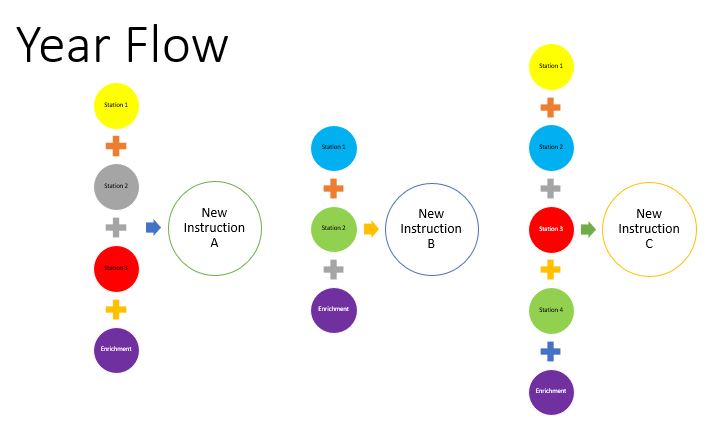
A Classroom Structure – Responsive Stations
There are many ways to structure your classroom to ensure
that your students are receiving the instruction that they need. These might
include classroom routines that focus on readiness skills, or rotational
stations like Daily 3 Math. One innovative structure is Responsive Stations.
Implementation
Once you have the pre-assessment data, students go to those
stations that their data on their pre-assessment indicates that they need.
Some helpful organizational hints include:
Colour coding your boards helps students know where they are heading.
Use a tracking sheet to monitor which pre-skills each student needs to address.
Use stickers as rewards to track what stations have been done.
Use a short post-assessment to determine that a student understands the content.
Use bins of materials at each station to help keep organized.
Include an enrichment station for those students who have pre-skills in place. This enrichment station can include games, additional math topics, and ideas such as creating new videos or games based on math concepts.
Once you have provided opportunities for students to be ready for your grade-level instruction, you can then teach new concepts using rich instructional practices that we know help students understand. Through the year, your class will revisit the same pre-skills over time, as many topics repeat as pre-skills throughout curriculum.
Sample Responsive Station Planners
These planners are living documents, created and revised by teachers.
If you are interested in learning more about the Assess-Respond-Instruct Framework for building readiness, or would like to bring professional development to your staff in this area, please contact Terry@johansonconsulting.ca
Comprehension strategies are ways in which we make meaning of the information we take in through text, media, and sound. Often considered the domain of the English Language Arts teacher, we now realize that it is important that teachers across subject areas and grades encourage meaning making and use tactics that cause learners to use strategies that they may or may not be fluent in.
Depending on which researcher you follow, you may categorize comprehension strategies into 6, 7, or even 13 different strategies. Following the framework of Ellin Keene (1997) in her book Mosaic of Thought: Teaching Comprehension in a Readers Workshop, this post identifies seven strategies that help learners make meaning of complex information. A detailed comprehension strategies summary describes the actions of readers, writers, mathematicians, and researchers.
While categorizing strategies and tactics is helpful, we need to keep in mind that the comprehension strategies are all interconnected. Visualization is grounded on activating and connecting knowledge. Determining importance and summarizing are closely related. Monitoring comprehension often creates self-questions. Each person has different comprehension strategies that their mind tends to use. Our challenge as teachers is to create a pause and opportunity for students to try stretching to new mental pathways.
Activating and Connecting Prior Knowledge
This comprehension strategy involves students connecting their learning to past experiences, events in the world, and to other learning they may have in and out of school. We simply can’t understand new information that we hear, read or view without thinking about what we already know. It is important that teachers teach learners to:
Relate to prior experience.
Make connections between text, media, and personal observation.
Connect the new to the known – use what learners know to understand new information.
When students are using this comprehension strategy, you may hear them say…
This reminds me of…
I noticed…
It made me think of…
I never knew…
That changed my mind…
This is different from…
Some tactics that teachers might use to promote activating and connecting prior knowledge include:
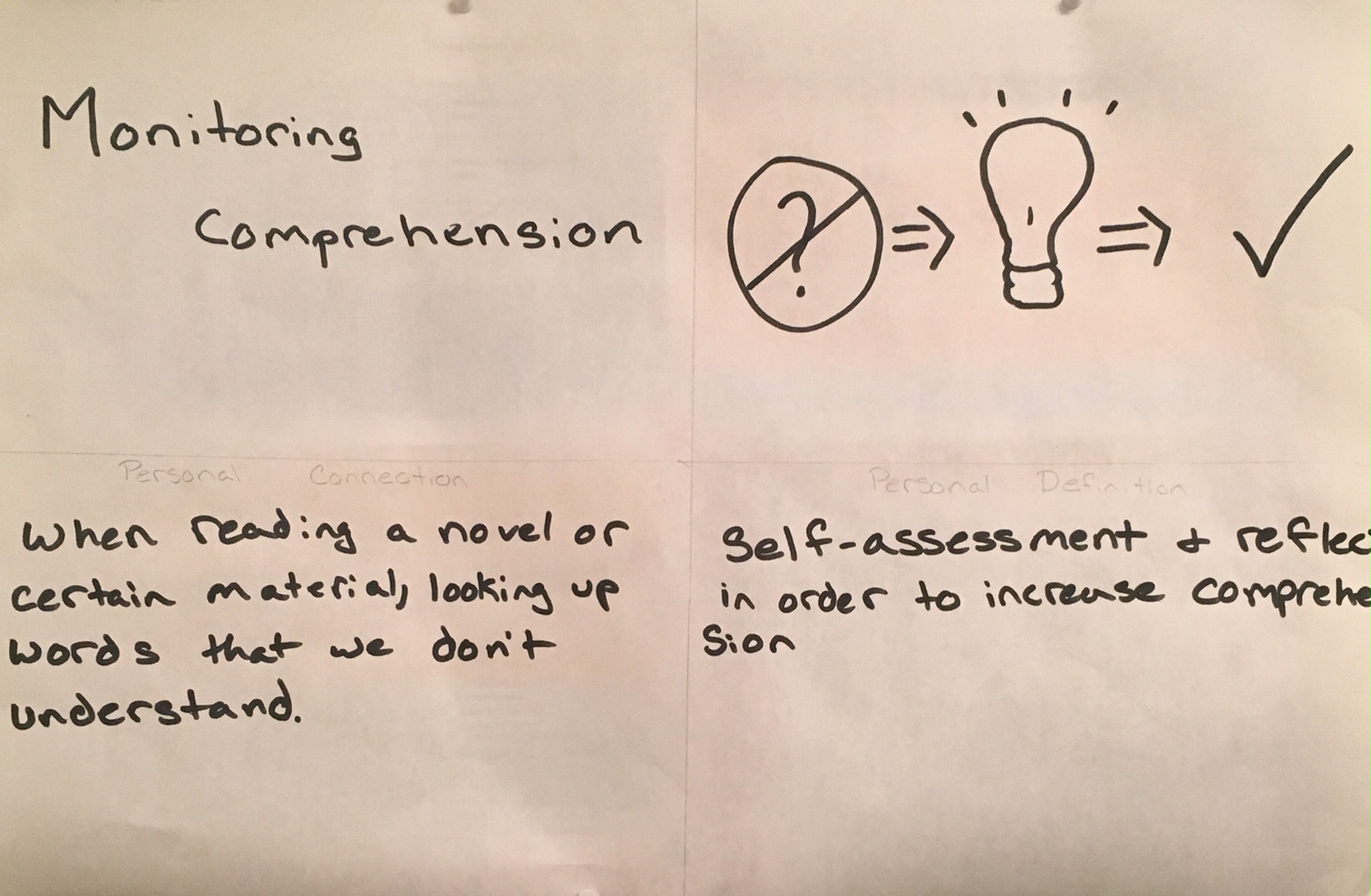
This comprehension strategy involves students recognizing and acting on their own confusion, and their self-questioning to determine understanding. We monitor our comprehension and keep track of our thinking in a number of ways. We notice when text makes sense and when it doesn’t. We ask questions, infer, activate background knowledge, and make connections, all in the effort to promote understanding. It is important that teachers teach learners to:
Become aware of their thinking as they read.
Notice when meaning breaks down and their mind wanders.
Employ ‘fix up’ strategies – reread for clarification, read ahead to construct meaning, use context to break down unfamiliar words, skip difficult parts and continue to see if meaning becomes clear, check and recheck answers and thinking, and examine the evidence.
When students are using this comprehension strategy, you may hear them say…
I think…
I understand…
This doesn’t make sense…
Oh, now I get it…
A part I had trouble with…
Some tactics that teachers might use to promote monitoring comprehension include:
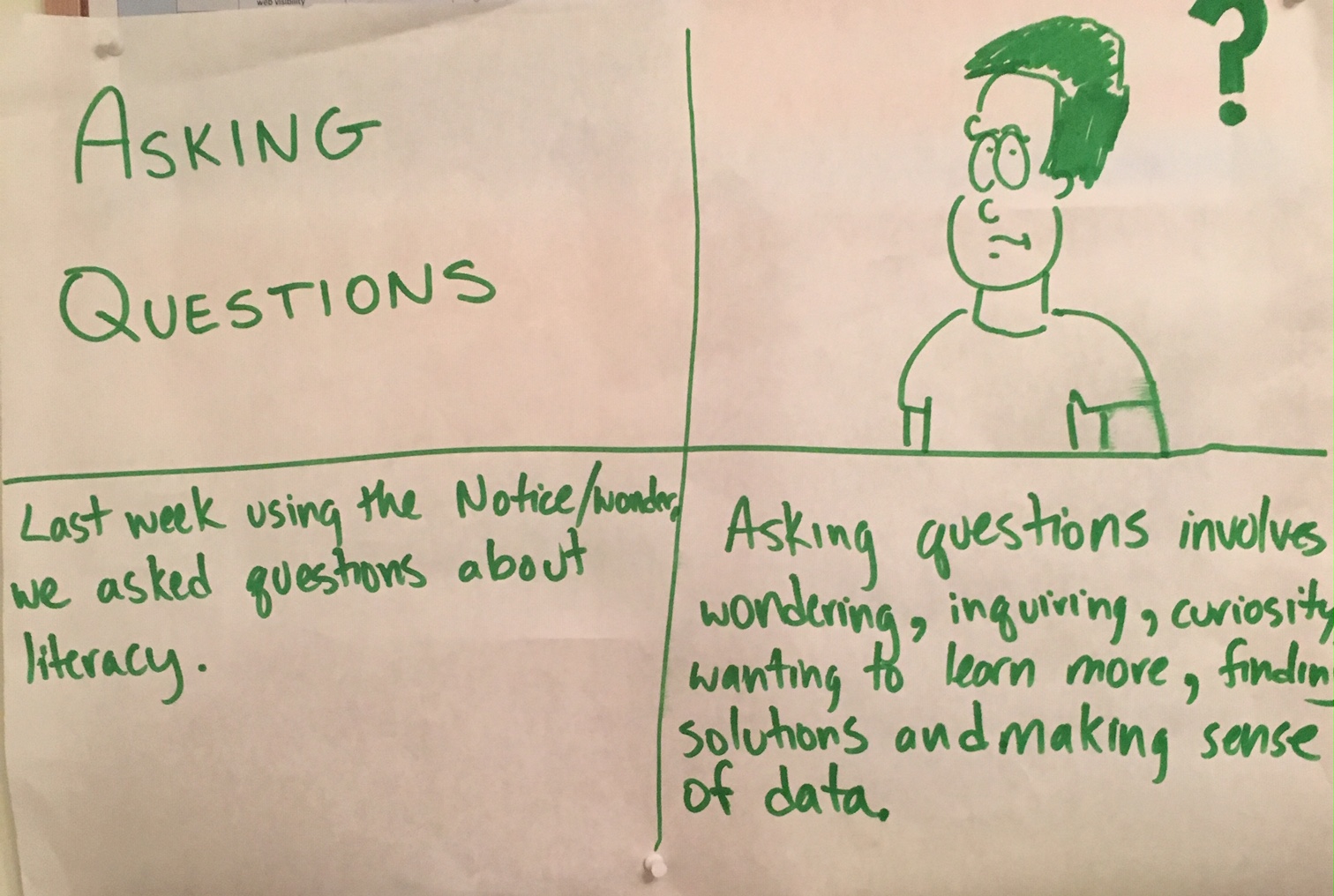
This strategy involves students actively wondering about topics and questioning facts and information. Questioning is the strategy that propels learners on and is at the heart of inquiry-based learning. Humans are driven to make sense of the world, and questions open the doors to understanding. It is important that teachers teach learners to:
Wonder about the content, concepts, outcomes, and genre of text.
Question the author.
Read to discover answers and gain information.
When students use this comprehension strategy, you may hear them say…
I wonder…
I’m curious…
My big question is…
Why…
Do you know anything about…
Some tactics that teachers might use to promote questioning include:
This comprehension strategy involves students predicting, hypothesizing, interpreting, and making conclusions. Inferential thinking allows learners to grasp the deeper essence of text and information. Readers infer by taking their background knowledge and merge it with clues int he text to draw a conclusion or arrive at a big idea that is not explicitly stated in the text. It is important that teachers teach learners to:
Use context clues to figure out meaning of unfamiliar words.
Draw conclusions from evidence.
Predict outcomes, events and observations.
When students use this comprehension strategy, you may hear them say…
I’m thinking…
It seems to me…
I’m guessing that…
I predict…
Probably…
Some tactics that teachers might use to promote inferring include:
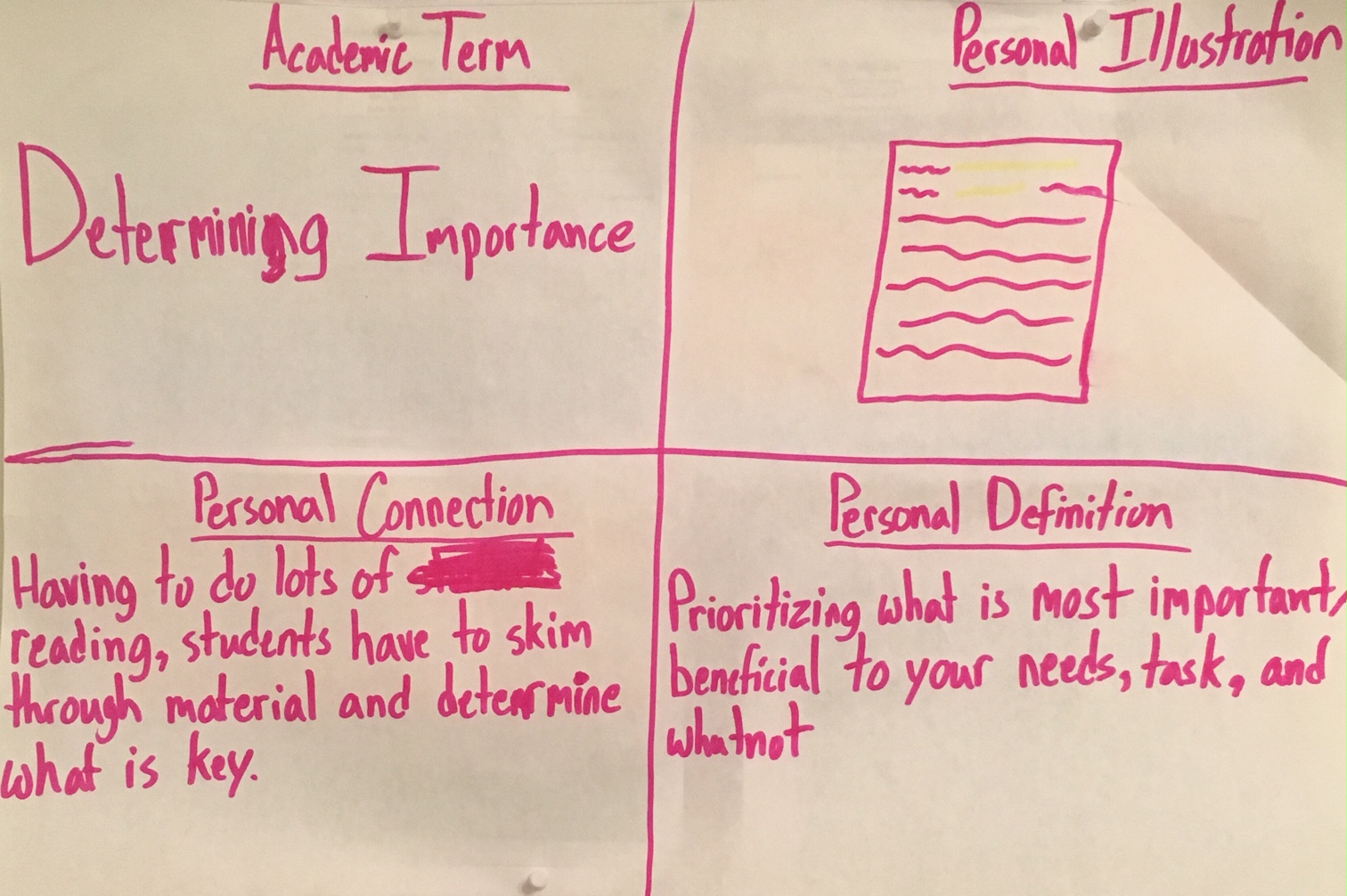
This comprehension strategy involves students evaluating information, making judgments about information, and identifying key ideas and concepts. We read nonfiction to learn, understand, and remember information. It is important that teachers teach learners to:
Target key information.
Choose what to remember.
Construct big ideas from smaller ideas.
When students use this comprehension strategy, you may hear them say…
This is really important…
The most important ideas here are…
So far, I have learned that…
I think this part means…
Some tactics that teachers might use to promote determining importance include:
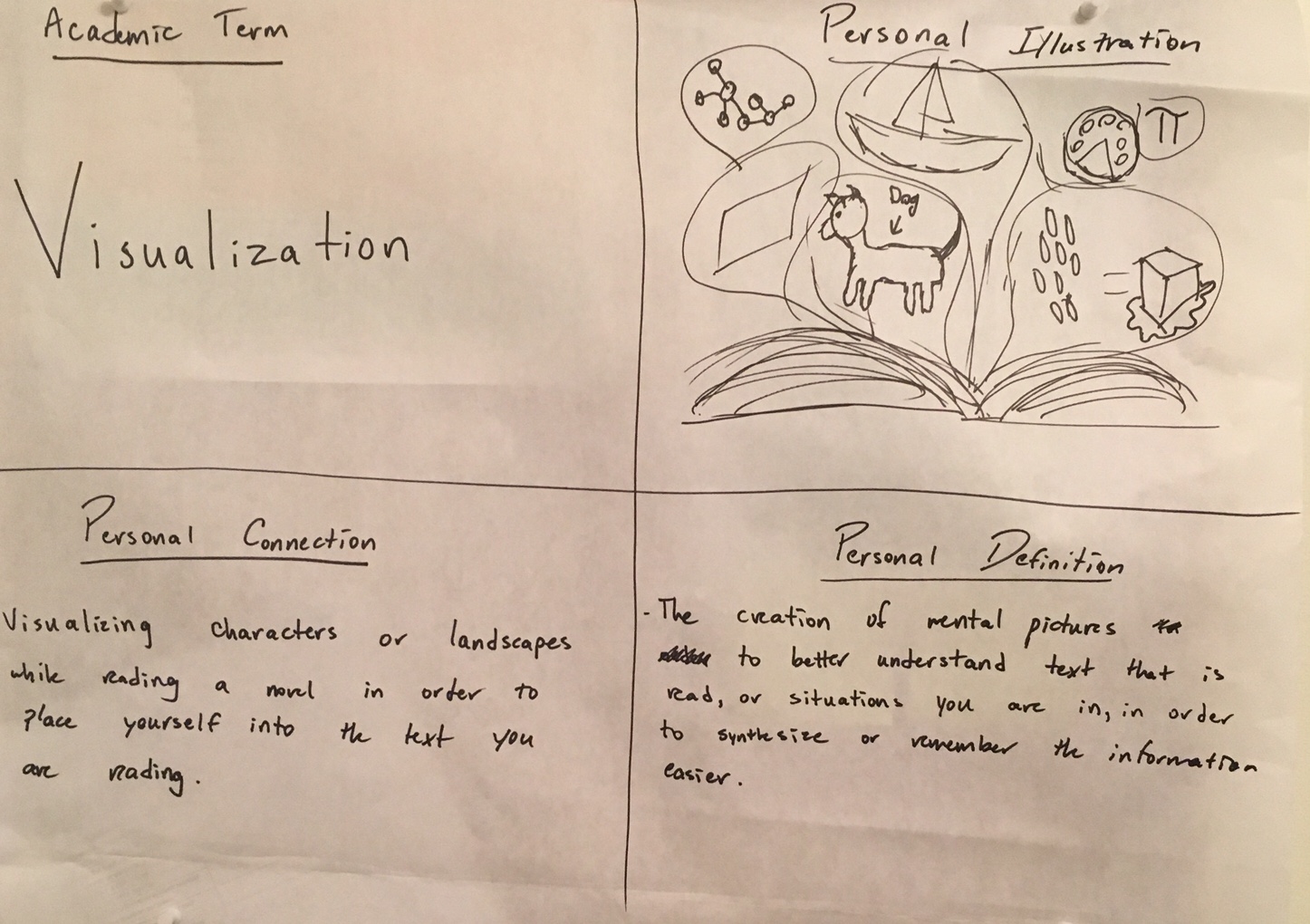
This comprehension strategy involves students making mental pictures and/or mind maps of ideas and how they interconnect. Visualization builds complex connections and involves more than just how something looks. It extends to other senses such as smell, touch, sound, and taste. It is important that teachers teach learners to:
Gain information from the images they construct and view.
Create mental images drawn from background knowledge and observations.
When students use this comprehension strategy, you may hear them say…
I am getting a picture…
I can see (smell, hear, taste)…
I have a picture in my head…
Some tactics that teachers might use to promote visualization include:
This comprehension strategy involves students recalling, retelling, creating new meaning, and remembering information. Synthesizing information allows us to see the bigger picture as we read or observe. Thoughtful readers merge their thinking with information to come to a more complete understanding. It is important that teachers teach learners to:
Add to their knowledge base.
Paraphrase information
Move from facts to ideas.
Summarizing and synthesizing are often used as synonyms. While they are related, they are different strategies that readers use. Sarah Eaton, a professor at the University of Calgary (2010, Summarizing vs Synthesizing), identifies these differences:
Summarizing
Synthesizing
A basic reading technique.
An advanced reading technique.
Pulls together information in order to highlight the important points.
Pulls together information not only to highlight the important points, but also to draw your own conclusions.
Re-iterates the information.
Combines and contrasts information from different sources.
Shows what the original authors wrote.
Not only reflects your knowledge about what the original authors wrote, but also creates something new out of two or more pieces of writing.
Addresses one set of information (e.g. article, chapter, document) at a time. Each source remains distinct.
Combines parts and elements from a variety of sources into one unified entity.
Presents a cursory overview.
Focuses on both main ideas and details.
Demonstrates an understanding of the overall meaning.
Achieves new insight.
Summarizing is taking the details of information apart while synthesizing is putting those details back together into a new and unique whole.
When students use this comprehension strategy, you may hear them say…
I never knew… now I know…
I think the big idea is…
I have learned that…
Now I understand that…
Some tactics that teachers might use to promote summarizing and synthesizing include:
When do we explicitly use Comprehension Strategy Tactics?
If the information that we are having students interact with is complex, it is important to use instructional methods that help them make meaning. As well, if we notice that students are struggling with a specific skill or content area, we can view comprehension strategy instruction a possible solution to those learning barriers. Teaching with comprehension in mind will lead to increased cognitive engagement and deeper meaning-making.
Eaton, S. E. (2010, September 26). Reading Strategy: The difference between summarizing and synthesizing. Retrieved from http://www.drsaraheaton.wordpress.com
Johanson, T., & Broughton, D. (2014). Exploring Comprehension in Physics. Saskatoon: McDowell Foundation.
Keene, E., & Zimmermann, S. (1997). Mosaic of Thought: Teaching Comprehension in a Readers Workshop. Portsmouth: Heinemann.
Public Education & Business Coalition. (n.d.). Thinking Strategies for Learners: A guide to PEBC’s professional development in reading, writing, mathematics and information literacy. Retrieved December 15, 2018, from Public Education & Business Coalition: https://www.pebc.org/wp-content/uploads/publications/thinking-strategies.pdf











 When students are using this comprehension strategy, you may hear them say…
 When students are using this comprehension strategy, you may hear them say…
 When students use this comprehension strategy, you may hear them say…
 When students use this comprehension strategy, you may hear them say…
 When students use this comprehension strategy, you may hear them say…
 When students use this comprehension strategy, you may hear them say…
 When students use this comprehension strategy, you may hear them say…
 Terry Johanson Consulting