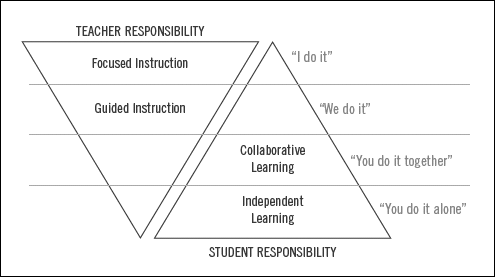
When planning for my newest workshop on the Gradual Release of Responsibility, I had a HUGE epiphany… when thinking about what the barriers to implementing this classroom structure, I realized that while research shows us that the Gradual Release of Responsibility Framework supports learners:
Fisher and Frey Framework for Gradual Release of Responsibility
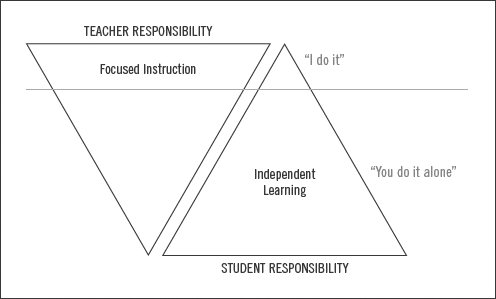
But too often, professional development follows this framework:
Fisher and Frey an Unhelpful Framework
And we know that this framework is not helpful to learners. Too often, we as designers of professional learning share our thinking and then expect teacher learners to implement on their own. This realization hit me like a brick. So how to use the Gradual Release of Responsibility framework as the design framework for professional learning?
Planning to Plan for Instruction
I Do: Modelling Planning
We Do: Shared Planning
You Do: Collaborative Planning
You Do: Independent Planning
I Do: Modelling Planning
Graphic organizers are useful tools for student and adult thinking. I began by designing a Gradual Release of Responsibility planning template that goes through the key steps in planning for instruction. Of course, it is important to recognize that the order of I Do – We Do – You Do is not the only order for instruction!
Starting with an example from the Grade 1 Science curriculum, I decided that the outcome and indicators focusing on seasonal changes would be a good place to insert student writing. From here, I started searching for a mentor text that I could use for modelling descriptive words and showing seasonal changes. I decided to use “Goodbye Winter, Hello Spring” by Kenard Pak. A helpful hint is to search a book title on YouTube to see if it fits what you are hoping for. When selecting a mentor text, it is important to identify the key questions that you might have students think about while you and they are reading.
Once I have the curricular connections and mentor text in place, I can then identify what I will include in my modelling/think aloud.
The “I Do” in this instructional sequence might include:
Features of the mentor text
Modelling writing
Mini lessons on writing or science related to this writing project
The “We Do” in the instructional sequence might include
Shared writing using the mentor text example
The “You Do: Together” in the instructional sequence might include
Collaborative rewriting of different passages of the book
The “You Do: Independent” in the instructional sequence might include
Drawings and description of one plant or animal that changes between the winter and spring seasons.
In shared planning, workshop participant and I will co-construct a second instructional sequence, choosing one outcome from a pre-selected list of outcomes that all lend themselves to student writing. For example:
If the outcome chosen is Grade 5 Social Studies: Government Structure, we can use “Canada Votes” as our mentor text. In many communities, it would be helpful for students to expand the description of government in this book to include First Nations governance and elections.
If the outcome chosen is Grade 3 Mathematics: Passage of Time, we can use “A Second is a Hiccup” as our mentor text. This would allow children to explore what activities take different measures of time.
You Do: Collaborative Planning
At this stage, teachers will work with grade-similar peers and co-create a series of lessons that they are interested in.
It is important here to co-construct criteria for what makes a good plan.
You Do: Independent Planning
Finally, teachers will use the planning template to create a series of lessons for their own curriculum. These ideas can then be shared through a Speed Dating structure so that peers can hear creative ideas that might apply to their own classrooms.
By using the Gradual Release of Responsibility framework to learn about the Gradual Release of Responsibility Framework, the hope is that teachers will be able to experience as learners the power of this model. When we experience something as learners, we have increased understanding and confidence to use it.
I have had the pleasure of working with two different organizations recently, helping their staff to understand some basic principles of designing professional learning experiences for teachers. Designing professional learning deserves as much care and attention as the planning that we expect classroom teachers to give to their classroom instruction. We do not accept undifferentiated teacher lecture as the only pedagogy in classrooms, so it is important that we design professional learning that is
NOT a prescriptive module that does not change, regardless of what learners need
NOT solely lecture-style presentation where we tell them information and leave the meaning making and application to teachers after an event.
In my decade of designing and facilitating professional learning and teaching others to design professional learning, I have been seeking out and creating ways to approach workshop design. My goal is to ensure that I provide rich, authentic, practical and differentiated adult learning to teachers and related professionals. I firmly believe that a day of teacher workshop must be as or more important than a day that teacher would have had with their students. And a day with their students is SO important.
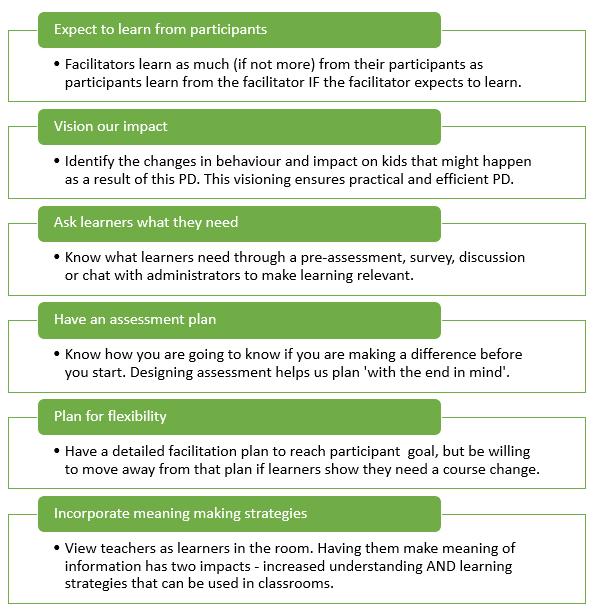
In my learning journey, I have discovered a few key things that are the foundation for every workshop that I create and facilitate.
Expect to Learn from Participants: Partnership Principles
One of my first learning opportunities about designing professional learning was Jim Knight’s Partnership Principles. His philosophy is very simple – that the people who come to professional learning are equal in every way to the facilitators of that learning. There is no hierarchy in learning, we are colleagues and partners.
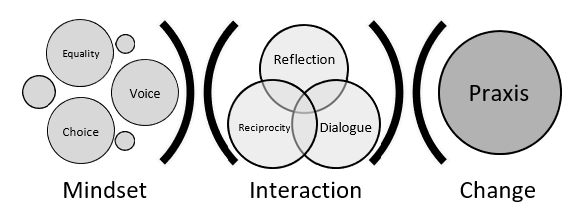
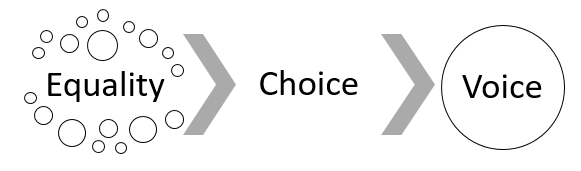
Jim Knight’s Partnership Principles identify that if we have a mindset of equality, where our learners have choice and voice with professional learning, we will create interactions that encourage dialogue, reflection where we both can learn. An ultimately, the goal is for praxis, or application and transfer of learning into teacher contexts and classrooms.
Vision Our Impact: What Change Are We Hoping For?
It is important to see what changes we are hoping for in teacher behavior, resulting in an impact on student learning. Following Thomas Guskey’s Five Levels of Evaluating Professional Development backwards, it is possible to pose questions that can be pre-thinking before we begin designing learning. This process helps us to identify WHY we are providing this professional learning. As Simon Sinek has identified in his talk on The Golden Circle, we often think about the WHAT and the HOW, but it is the WHY that inspires us. When we, as facilitators, know why, we can share that passion and enthusiasm with our adult learners. A helpful tool is to use a Thinking Map, along with the following questions:
Ask Teachers What They Need
Ideally, we can engage teacher learners before our learning event to find out what learners need. This might be informed by:
Observations of student behaviours – what changes are needed?
Observations of student learning – what gaps or areas do students need a greater focus on?
Observations of teacher knowledge – what would learners like to know more about or change in their own understanding?
If it is not possible to have this conversation before learning, there are different facilitation processes that can be done that can inform our facilitation. These include:
Personal Inquiry – participants identify a question that they most want to answer through the day. This is put onto a sticky note that they revisit and discuss at the end of the day with a colleague.
Have an Assessment Plan: Guskey’s 5 Levels
Thomas Guskey has identified five levels of evaluation to consider when understanding the efficacy of any professional learning experience in his article “Does it Make a Difference? Evaluating Professional Development”. Too often, we take in data around student outcomes and teacher satisfaction but neglect to identify the levels in between that allow us as facilitators to draw conclusions and connections between the professional learning that we are engaging in and the impact on students.
As Guskey has stated, “Good evaluations don’t have to be complicated. They simply require thoughtful planning, the ability to ask good questions, and a basic understanding of how to find valid answers” (Guskey, 2002). It is important as we evaluate our professional learning experiences that we are looking for evidence around its efficacy, not proof that it is making a difference. Most often, there are many different professional experiences that are impacting student learning, and to identify the exact scope and impact of any one initiative is nearly impossible. Instead, it is useful to gather evidence, both qualitative and quantitative, that identifies shifts and possible contributors to changes in student learning.
Guskey’s Five Levels of Evaluating Professional Development allow us to consider the types of questions that we might ask participants during or after professional learning. Facilitators who can connect with teachers after professional learning can gather data regarding impact on student outcomes and participant use of knowledge and skills.
If you are only in contact with educators during a session, it is possible to assess levels one through three, and measure teacher intent to implement using an Agenda Assessment. An agenda assessment is an innovation that combines an agenda with an assessment of learning and can be completed throughout a professional learning experience. This information can give insight into the effectiveness of a workshop or other learning experience.
Plan for Flexibility: Have a Plan that Allows for Change
A useful planning structure is a Facilitation Guide. Like a lesson plan that a teacher might use in a classroom, a facilitation guide identifies content, process, assessment, timing and materials. This simple structure helps facilitators see how content is chunked during the day, and the sequence of instructional strategies.
Content: This is the sequence of main ideas that flows through the day. By chunking content, it is relatively easy for a facilitator to skip or skim over particular ideas. This might occur if
Teachers have already identified that they know a specific piece of information; or
Time does not allow for all of the concepts in the day to be covered.
Process: This column identifies the instructional strategies and key questions that facilitators might pose to encourage thinking.
Assessment: This column allows facilitators to predict what they think participants might do or say during a specific part of the workshop. It is helpful to identify
what people might say if they have a misconception; or
what we are looking for in participant responses that indicates that they understand.
Timing: Just as it states, this column allows facilitators to predict the length of time that a specific process will take. This helps to know whether the workshop is at, ahead or behind timelines outlined.
Materials: This column has us list materials or resources that are used in that chunk of a workshop.
Incorporate Meaning Making Strategies: Differentiate Learning
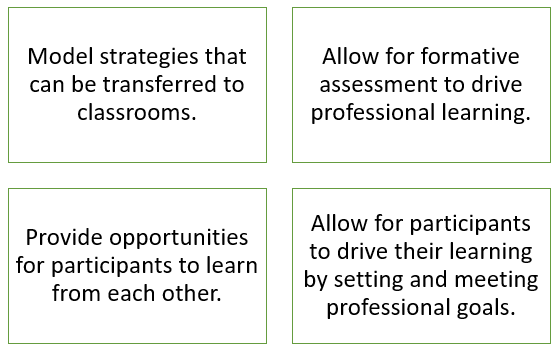
It is important that we choose processes for learning that fit the content and amount of time provided. Considering Dylan Wiliam’s Formative Assessment Strategies, instructional strategies in professional learning are particularly powerful when they:
So, where do we find these strategies? There are many useful resources. Some of them include:
It may seem like there are many layers and lots of time needed to plan effective professional learning, but our teachers and ultimately student learning deserve our investment.
This blog post is a work in progress! Be sure to come back and visit in a few weeks, as I will be adding to it over time…
It can sometimes feel overwhelming when we look at all of the individual and group needs of our mathematics learners. Building readiness to learn, along with ensuring that we meet the individual needs of students might give us the impression that we need to create an individual lesson plan for each and every person in our classrooms. That sounds exhausting…
But what if we can create structures and use a variety of math instructional strategies within those structures? What if we can create diverse learning experiences that encourage mathematical thinking and growth over key concepts? This is an idea worth investigating!
Our elementary and middle years math curricula in Saskatchewan cover a number of topics, from number to patterns to shape and space and statistics. Ironically, when you look at the skills needed for students to be READY to engage in these grade-level concepts, there are only a handful of pre-skills. These pre-skills are the math concepts that are applied and used in new learning.
For example, when we are learning about adding and subtracting fractions, we need to know about:
addition and subtraction
multiplication and division, multiples and factors
what a fraction is, finding equivalent fractions, improper fractions
So, how do we teach and reteach each of these key concepts in our classrooms? You can find a large number of curated resources in this Google Drive which contains folders of resources
We can also pull out specific concepts and see how they grow. The following concept trajectories were created by a province-wide math leadership group a number of years ago, and show the language, strategies and concepts over time. Each continuum has four instructional strategies listed.
Classroom management is the part of teaching that is invisible when it is working well, and highly visible when we and our students are struggling. Sometimes it may feel like herding cats:
Classroom Management’s purpose is to “provide structure while helping students develop autonomy, awareness and self-regulation skills” (Emerich France, 2018).
Traditional classroom management theories rely on teachers viewing student behaviour as a matter of choices or intentional defiance. As a result, traditional solutions have been a list of consequences and rewards. While consequences may be a part of a classroom management plan, if the goal of classroom management is to have students understand themselves and self-regulate, teachers and students need to first identify the causes of behaviours, attempt to prevent triggers and increase self-awareness.
General principles of Discipline with Dignity (Curwin, Mendler, & Mendler, 2018) are:
This perspective of classroom management allows us to link the effects of trauma and brain development to understanding some of the underlying causes of student behaviours. Classroom management is founded on knowing our students and building relationships with them.
Basic Needs that Drive Behaviour
Curwin, Mendler, and Mendler (2018) and Dr. Martin Brokenleg (Circle of courage, 1990) have identified what our and our students’ basic human needs are in order to be healthy and whole.
Curwin, Mendler, and Mendler
Dr. Martin Brokenleg
Identity – “how we view ourselves and how we feel about ourselves”
Attention – “the need to be acknowledged by others in a way that makes us feel that we matter”
Generosity – to give our knowledge, skills, insight, experience, and resources to others; receiving a sense of purpose from strengthening the community
Connection – “our need to feel that we belong to something that matters to us”
Belonging – to feel valued, affirmed and significant within the group; believing in the importance of a shared purpose; to identify with shared goals
Competence – “feeling that we know how to do something”
Mastery – to develop abilities, skills, and knowledge in order to take risks, to try new things and learn from others; to embrace challenges and learning
Control – “the desire to make decisions that count, to have real choices, to control our environment”
Independence – to feel in control of our learning; to have a sense of competent autonomy and to contribute to responsibility
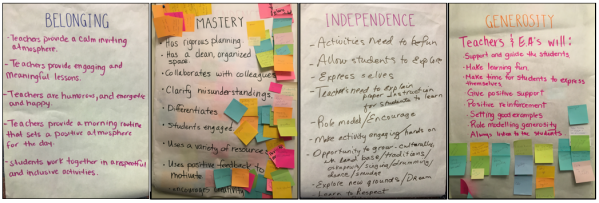
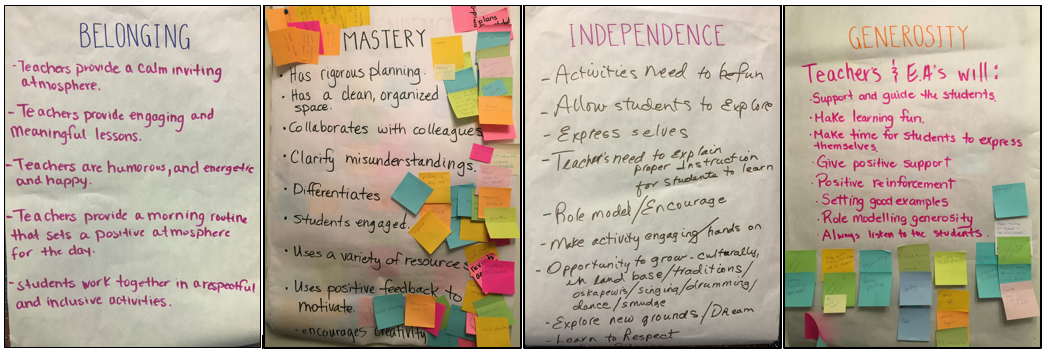
Saskatchewan teachers and educational assistants used a Circle of Courage graphic organizer to brainstorm what they need to keep in mind to create a learning environment that fosters a sense of belonging, mastery, independence, and generosity in their students:
A school environment that provides opportunities for students to have their needs met is part of a “prevention mindset” (Curwin, Mendler, & Mendler, p. 61). Looking at prevention from the student perspective, appropriate behaviour is generally achieved when students:
Feel connected to the teacher, one another, and the curriculum.
Believe that success is attainable with reasonable effort.
Feel respected by being heard; feel teachers strongly care about them in personal ways.
Are given responsibility, especially in helping other children. This involves giving appropriate choices throughout the day.
Look forward to sanctioned moments of joy and laughter every day.
Believe that what is being taught is relevant.
Activating Peers as Learning Resources
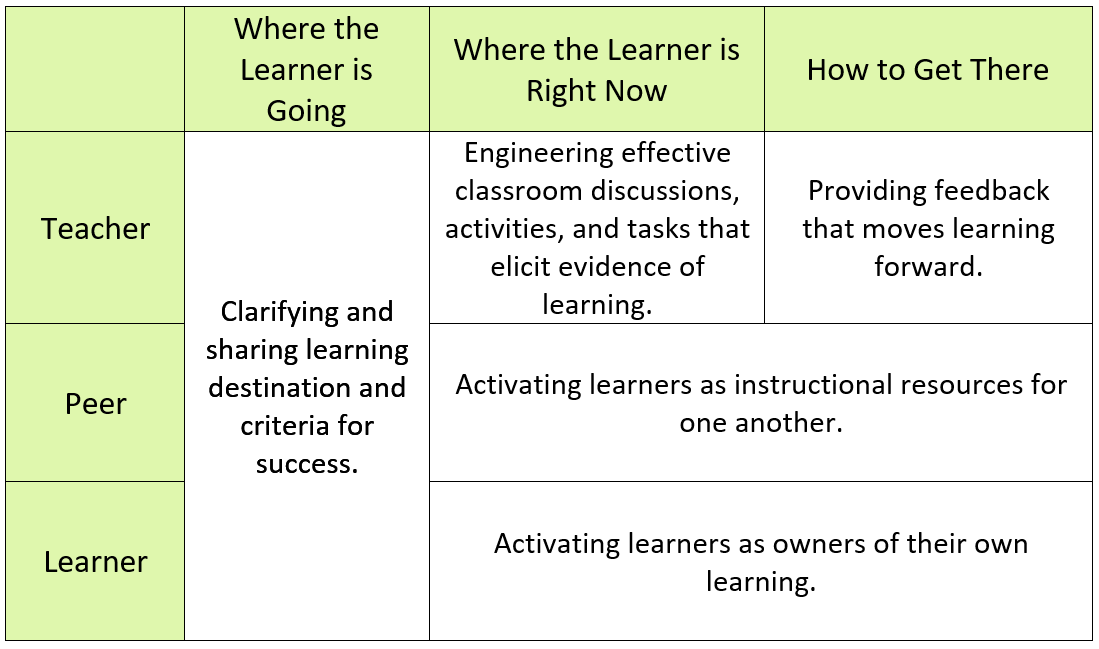
Dylan Wiliam has identified five strategies for Formative Assessment, which increase student engagement and achievement.
Wiliam’s work guides our instruction in many ways, including how to activate learners as instructional resources. Collaborative learning that encourages group goals and individual accountability is more powerful than simply having students work on tasks in a group. This group work increases student sense of belonging and provides a space for generosity within a community of learners.
Wiliam (2011) identifies why students benefit from helping their peers:
they are working towards a common goal and they benefit from the efforts of all, resulting in increased motivation.
they care about their group members, resulting in social cohesion.
they understand and can address the difficulties their peers are having, resulting in personalization.
thinking together brings clarity, resulting in cognitive elaboration.
Assessment Strategies
Wiliam writes about a number of strategies that can enhance peer support of learning within a classroom.
Peer Evaluation of Homework – The class or teacher create criteria (rubric) for the work. Who is assessing the work changes and is not announced until the homework is complete. Evaluators may be: Self, Other – individual or group or Teacher
Two Stars and a Wish – student feedback on other students’ work – 2 positive qualities and a suggestion for improvement; Teacher needs to instruct students on what quality feedback looks like. Sentence starters can be useful to give to students in advance.
Preflight Checklist – When there are specific requirements or features of a piece of student work, this list is checked by a peer prior to the work being handed in. If there are pieces missing that were on the checklist, the peer is the one held accountable.
Group-Based Test Prep – Within a group, each student is assigned a different part of a unit to review. They prepare and present their review to their group. Peers assess the review using coloured cups (red – not as good as I would have done; yellow – about the same as I would have done; green – better than I would have done).
Teaching and using group work goes beyond learning styles, and can enhance student motivation, engagement and resilience.
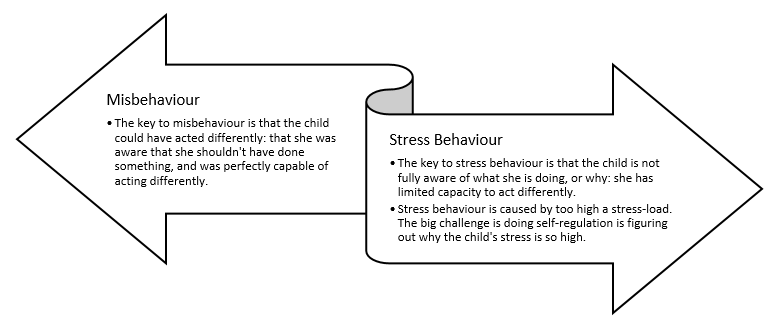
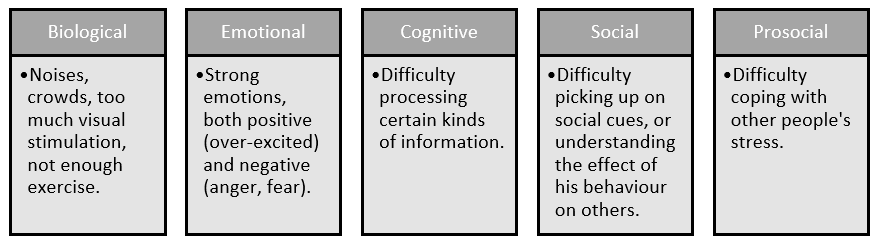
Brain research has shown that there are differences between stress behaviours and misbehaviour. If we treat them in the same way, it can be hard on our students and hard on ourselves.
“Trauma has a powerful capacity to shape a child’s physical, emotional, and intellectual development, especially when the trauma is experienced in early life” (JBS International and Georgetown University National Technical Assistance Centre).
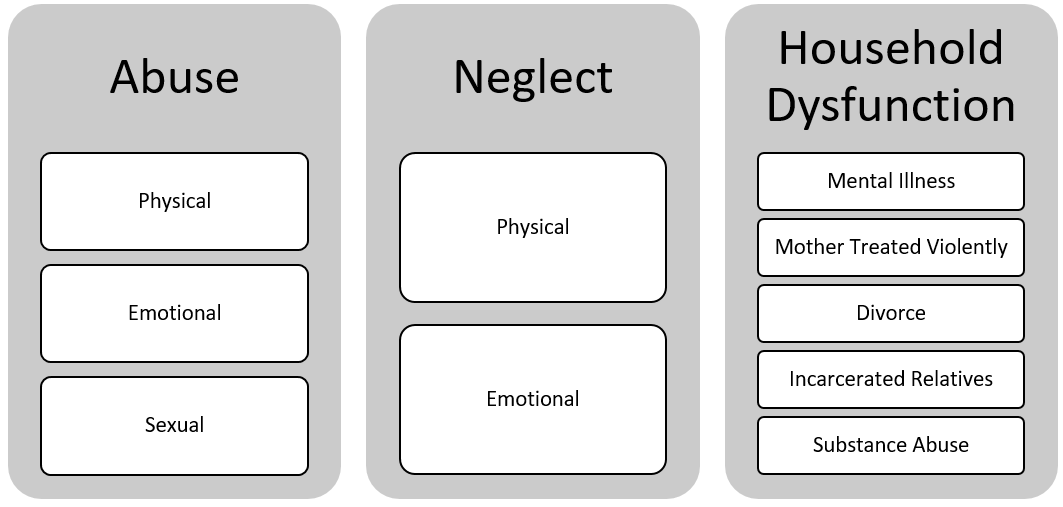
There are significant impacts of ACEs on individual health outcomes. Brain science has determined that ACEs disrupt neurodevelopment, which leads to social, emotional and cognitive impairment, adoption of health-risk behaviours, disease, disability, and social problems and eventually can lead to early death.
Continued exposure to trauma creates an environment filled with relentless fear, resulting in the development of a self-defence mechanism in a child’s brain that requires a fight, flight or freeze response. Stress responses are maintained due to:
A persistent fear response that ‘wears out’ neural pathways;
Dissociation from the traumatic event in which the child shuts down emotionally; and
Disruptions in emotional attachment, which can be detrimental to learning.
(JBS International and Georgetown University National Technical Assistance Centre).
Intergenerational and Historical Trauma
The Georgetown University National Technical Assistance Centre for Children’s Mental Health has identified two types of trauma that may have an impact on children in schools:
Intergenerational trauma results when disturbing experiences have not been addressed and their emotional and behavioural legacy is passed down from parents to their children. Parents who experienced persistent trauma in childhood may struggle with their own ability to express empathy, compassion, and self-regulation. Unresolved trauma may make it difficult for parents to build trusting relationships and healthy attachments. This trauma is then transmitted to future generations.
Historical trauma goes beyond a single family to a community caused by historical, systematic abuse and injustice. In additional to family-specific intergenerational trauma, historical trauma may also result in shame and loss of culture and identity. The legacy of historical trauma can result in “repression, dissociation, denial, alcoholism, depression, doubt, helplessness, and devaluation of self and culture”.
Brain Malleability
While trauma affects brain development, causing structural and hormonal changes, the malleability of the human brain brings us hope. Because the brain can heal, and new neuropathways can be developed, teachers and schools can impact the long-term social, emotional and physical impacts of trauma. Trauma-informed schools are those where the school climate, instructional designs, positive behavioural supports, and policies are created so that traumatized students have what they need to achieve academic and social competence (Craig, 2016).
The goal of PBIS is to create a positive school climate, in which students learn and grow.
A process through which children and adults acquire and effectively apply the knowledge, attitudes, and skills necessary to understand and manage emotions, set and achieve positive goals, feel and show empathy for others, establish and maintain positive relationships, and make responsible decisions.
Dr. Bruce Perry has done significant research in the area of mitigating the impact of trauma on children.
Dr. Perry contributes to the Child Trauma Academy, which makes a number of free resources available.
Solutions in classrooms directed at brain stem activity can help create new pathways in the brain’s cortical areas. These include
patterned rhythmic activities
walking
dancing
singing
meditative breathing
create a calmer cognitive state so higher order thinking can occur
scaffold new information on prior knowledge
use classroom discourse purposefully
peer collaboration
provide direct instruction
Instruction and school environments that provide calming opportunities can help children learn to be more self-aware and foster their own emotion regulation, which then impacts the behaviour-consequence cycle.
As teachers, when we understand the underlying causes of student behaviour, we can not only respond, we can avoid triggers. Classroom Management is more than just the strategies we use, it is the relationship and understanding of the children we teach in order to help children build new neural pathways, understand their own behaviour and learn to self-regulate.
When and Where to Refer Students?
Sometimes, we might recognize that one of our students requires additional supports. Central Office personnel or support teachers may be able to help you assess where your students are at. For parents, Amy Morin writes about some of the indicators that a child might require targetted services in her blog post “When Should Parents Seek Help for a Child’s Behavior Problems?”. Supports from outside of your school system may be available through your regional health authority, which is listed on the Saskatchewan Health Authority’s Website. In the Prairie North Health Region, for instance, there are a number of youth-focussed supports in North Battleford.
Craig, S. E. (2016). Trauma-Sensitive Schools: Learning Communities Transforming Student Lives K-5. New York: Teachers College Press.
Curwin, R. L., Mendler, A. N., & Mendler, B. D. (2018). Discipline with Dignity: How to Build Responsibility, Relationships, and Respect in Your Classroom. Alexandria: ASCD.
Embedded coaches and mentors are a powerful model of professional learning. As colleagues, they work collaboratively with peers to support and extend professional knowledge. Part of working as embedded coaches is to ensure a shared vision and understanding of WHY coaches exist and their impact on teaching and learning.
Simon Sinek describes the “Golden Circle”, which has us begin with WHY, and then move to HOW and WHAT. The specific strategies, processes, and structures we use are based on that why.
Based on this theory, coaches can use a Thinking Map to brainstorm together their impact on students, what teachers might do in order to have this impact, what they are doing to support teacher growth and the barriers they are experiencing in their work. From this brainstorm, coaches can define their role collaboratively.
One concern often surfaced by coaches and mentors is that they struggle with beginning a helping relationship with colleagues. How do we start without judging colleagues? How do we ensure that teachers don’t feel that they are being judged as ‘broken’? As helper-leaders, it is sometimes difficult to know how to start.
Simple Truths About Helping
Jim Knight (Unmistakable Impact: A Partnership Approach for Dramatically Improving Instruction, 2011) has identified Five Simple Truths About Helping. These truths might be some of the barriers you are feeling as a coach or mentor with colleagues.
Simple Truth: People often don’t know that they need help
“It isn’t that they can’t see the solution. It is that they can’t see the problem.” ~ G. K. Chesterson.
The first step needed for change to occur is to recognize that we need to make a change. As professionals, it is often the case that when we realize that there is knowledge we need to have or a problem we need to solve, we will seek solutions for ourselves. The issue with precontemplation is that we might be blind to the learning or change that we most need to move forward.
Simple Truth: If people feel “one down”, they will resist
Issues related to status in helping relationships are often unanticipated. Coaches often see themselves as helpers rather than having a status that is more or higher than their teacher colleagues.
The very act of helping, Schein (2009) says, puts the coach or mentor “one-up” in a relationship. A teacher, either consciously or subconsciously, will resist being “one down”.
Helping situations are intrinsically unbalanced… Emotionally and socially, when you ask for help you are putting yourself “one down.” It is a temporary loss of status and self-esteem not to know what to do next or be unable to do it (p. 32).
Coaches who are able to recognize that a colleague needs to maintain status will, as Schein says, “equalibrate” their relationship. This involves downplaying their own status and elevating the teacher by calling attention to insights and teaching skills and downplaying their own status and success.
Simple Truth: Criticism is taken personally
“Teacher identities are wrapped up in their perception of their ability to teach.” ~ Jim Knight
Our perceptions and stories of ourselves can be biased slightly in our favour. The narrative in our head protects our self-esteem to explain why we are not meeting our goals. A targeted conversation about teaching practice is not uncomfortable because of what another person may think, it might be uncomfortable because we might have to change what WE think.
Simple Truth: If someone else does all the thinking for them, people will resist
Teachers are knowledge workers, they think for a living. Not only do they think to do their jobs, but they are also creating a learning environment in which their students think. Much like learning in a classroom, professional learning needs to be at a level of appropriate challenge. We know that telling student learners what to do and how to do it stifles the joy of learning. The same is true for adult learners.
Simple Truth: People are not motivated by other people’s goals
“Goals that people set for themselves and that are devoted to attaining mastery are usually healthy. But goals imposed by others can sometimes have dangerous side effects.” ~ Daniel Pink
Research shows that people performing algorithmic tasks, those which you follow a set of steps down a single path to one conclusion, may respond well to extrinsic rewards and punishments. Teaching, however, is a considered to be a heuristic task. Heuristic tasks are those which there is no single algorithm and act as an experiment to create novel solutions. External rewards are not helpful with heuristic tasks, and as Jim Knight notes from Daniel Pink’s research (2009) “they can be “devastating for heuristic ones” (p. 30) because they reduce intrinsic motivation and the value people assign for each task” (2011, p. 27).
According to Pink (2009), there are three factors that can help to motivate people doing heuristic tasks or work:
Mastery: Doing a job well
Autonomy: freedom to choose goals and how to achieve them
Purpose: doing work that is making a difference, being part of something larger than ourselves
The Partnership Principles
So, what can help with helping? Jim Knight (2011) identifies the Partnership Principles, which are embedded in many of his books about coaching, including his Partnership Learning Fieldbook. Knight’s Partnership Learning Approach (2011) is a collaborative conversation between professionals. Unlike cognitive coaching, partners both contribute to the goals and outcome of the conversation.
“You can get to an understanding of the partnership approach by considering how you would answer a simple question: “If someone was talking with you about your work, how would you like them to relate to you?” Chances are you would want them to treat you as an equal, to respect your knowledge enough to let you make some decisions about how you do your work. You would probably also want them to ask your opinion and listen to your voice, to talk with you in a way that encouraged through and dialogue about your real-life experience. If they also demonstrated that they expected to learn from you, it would probably make it all the more likely that you would listen to them.” (Knight, p. 28)
Equality: Learning With Rather Than Done To
Equality is central within any partnership. Partners do not decide for each other; they decide together. In a true partnership, one partner does not tell the other what to do; they discuss, dialogue, and then decide together. Partners realize in healthy partnerships they are a lot smarter when they listen to their partner- when they recognize their partner as an equal.
Jim Knight, Unmistakable Impact
Learners who embrace the principle of equality recognize that in a partnership, the goal is not to win the other side over to their view. Rather, the goal is to find a match between what they have to offer and what a teacher can use. In the truest sense, if someone does not agree with our view of the world or our perspective, in a partnership the first step is to not argue our point more persuasively but to try to fully understand the collaborating teacher’s view or perspective. (Knight, 2011)
Choice: What and How They Learn
“Teachers should have choice regarding what and how they learn” (Knight, 2011, p. 31). If we believe in professional equality then it follows that all professionals have the right to make decisions regarding what and how they learn. When change leaders do not provide choice to professionals, it immediately negates a sense of equality and can promote a sense of “one-up” that can erode a sense of professional equality. Just as with learners in a classroom, a complete choice is not possible. Complete freedom is not the answer, as there are times when a school or system needs teachers to have a shared understanding and implementation of teaching practices.
Voice: Learning Empowers and Respects all Voices
“If partners are equal, and if they choose what they do and do not do, they should be free to say what they think, and their opinions should count” (Knight, 2011, p. 34). When learning in partnership, all voices are equally respected. “When we take the partnership approach, we create opportunities for people to express their own points of view. This means that a primary benefit of partnership is that everyone gets a chance to learn from others because others share what they know” (Knight, 2011, p. 34).
How does this impact coaching? Jim Knight (2011) has some suggestions:
Enter into conversations by asking questions, and wait for others to say what they think;
Temporarily set aside your own opinions so you can really hear what others have to say;
Truly value your colleagues’ perspectives;
Enter conversations expecting to learn from your colleagues; and
Effective practices are shared rather than mandated, allowing teachers to make connections and figure out how to implement in their context. Tools that empower teachers to be more organized, have a deeper understanding of content and process and connect to more students can inform teacher voice.
Reciprocity: Everyone Learns
Reciprocity is the belief that each learning interaction is an opportunity for everyone to learn – an embodiment of the saying, “when one teaches, two learn.” People who live out the principle of reciprocity approach others with humility, expecting to learn from them. When we look at everyone else as a teacher and a learner, regardless of their credentials, we will be surprised by new ideas, concepts, strategies, and passions. If we go into an experience expecting to learn, much more often than not, we will.
Dialogue: Thinking Together
Dialogue is a sign that we truly respect our partners. Dialogue is talking with the goal of digging deeper and exploring ideas together, or “thinking together”. Paulo Freire describes dialogue as a mutually humanizing form of communication. We become more thoughtful, creative, and alive when we talk in ways that open up rather than shut down.
As Martin Buber (1970) explains, if I use language to get people to do what I want them to do, if I manipulate, then I treat them like objects, not subjects. An antidialogical approach is truly dehumanizing. It is only when I encourage and tap into my partner’s imagination, creativity, knowledge, and ideas, that I truly respect them as fully human.
Reflection: Accept or Reject Thinking
When we take the partnership approach, we don’t tell others what to believe; we respect our partners’ professionalism and provide them with enough information so they can make their own decisions. Partners don’t do the thinking for their partners. Rather, they empower their partners to do the thinking. Reflection stands at the heart of the partnership approach, but it is only possible when people have the freedom to accept or reject what they are learning as they see fit.
Praxis: Apply Learning to Real-Life Practice
The ultimate goal of all forms of professional learning is for teachers to apply their learning in their contexts. In a partnership approach, how this occurs is that teachers are given time to reshape new ideas, integrate them into existing practices and implement ideas in a way that makes sense. Praxis is defined as the say that we apply new ideas into our lives. This is the foundation for change in education.
In order for praxis to occur, teachers need to consciously decide to implement or not implement and in what ways. They need to make sense of the idea and connect it to their prior learning. Praxis is not memorizing a new routine or using a new program. Praxis is a conscious choice to make conscious decisions regarding teaching practice.
Having the skills to build learning relationships with teacher colleagues is key to the effectiveness of coaches and mentors. Professional relationships and a clear vision for WHY we do this work can build positive learning-focussed conversations that move learning forward for both teachers and coaches, and ultimately provide supports for students in our classrooms.












 Embedded coaches and mentors are a powerful model of professional learning. As colleagues, they work collaboratively with peers to support and extend professional knowledge. Part of working as embedded coaches is to ensure a shared vision and understanding of WHY coaches exist and their impact on teaching and learning.





 When we take the partnership approach, we don’t tell others what to believe; we respect our partners’ professionalism and provide them with enough information so they can make their own decisions. Partners don’t do the thinking for their partners. Rather, they empower their partners to do the thinking. Reflection stands at the heart of the partnership approach, but it is only possible when people have the freedom to accept or reject what they are learning as they see fit.
 Terry Johanson Consulting