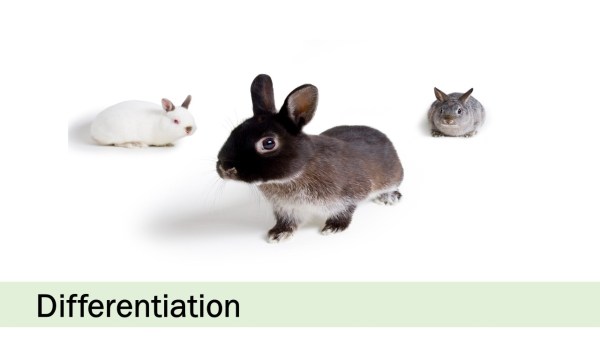
Differentiating Instruction – Why, How, What?

How often have we been in a conversation with a colleague about trying to meet the needs of all of our students, and we hear the dreaded phrase “well, just differentiate”… this blanket statement can bring about visions of creating 18 different lesson plans for our 18 students. This is not sustainable, so what is differentiation REALLY? How do we meet the needs of diverse learners and keep our sanity?
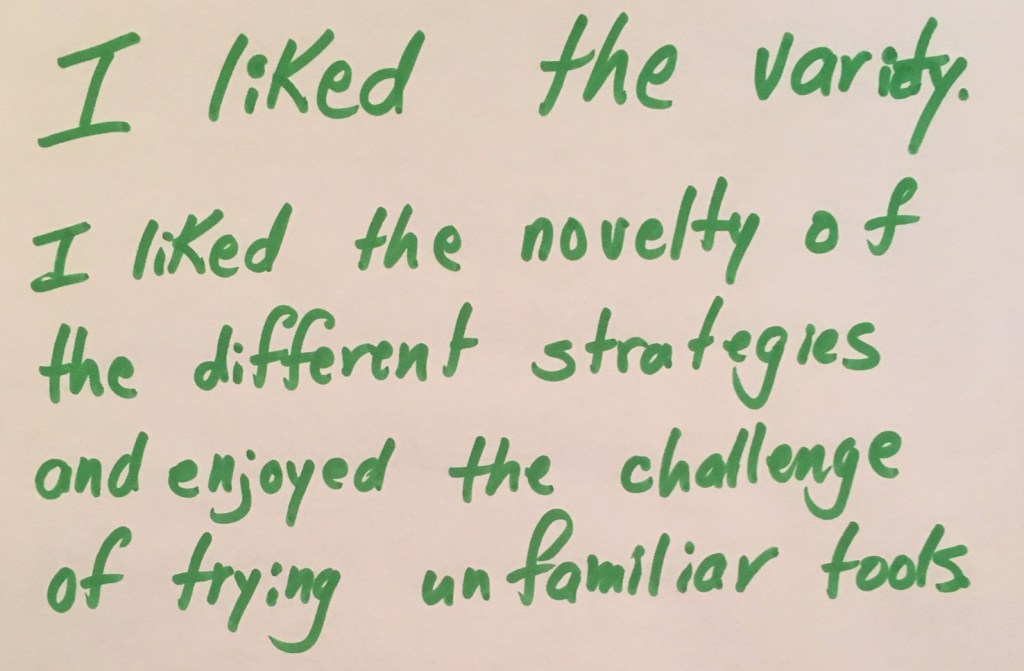
Picture Feedback 2

Workshops focussing on differentiation are, ironically, often not differentiated. It is important that all professional learning, including those experiences based on the topic of differentiation, attempt to have teachers experience differentiated learning as well as reinforce the foundations of how and why we differentiate content, process, product and environment for students. 

Planning for Differentiation

It is important to understand not only specific strategies but to also know why we might differentiate. What information do we need as teachers in order to plan appropriately for our individual students as well as our whole class experiences? We need to know a combination of Learning Styles, Multiple Intelligences, content readiness, and student interests in order to Plan for Differentiation.
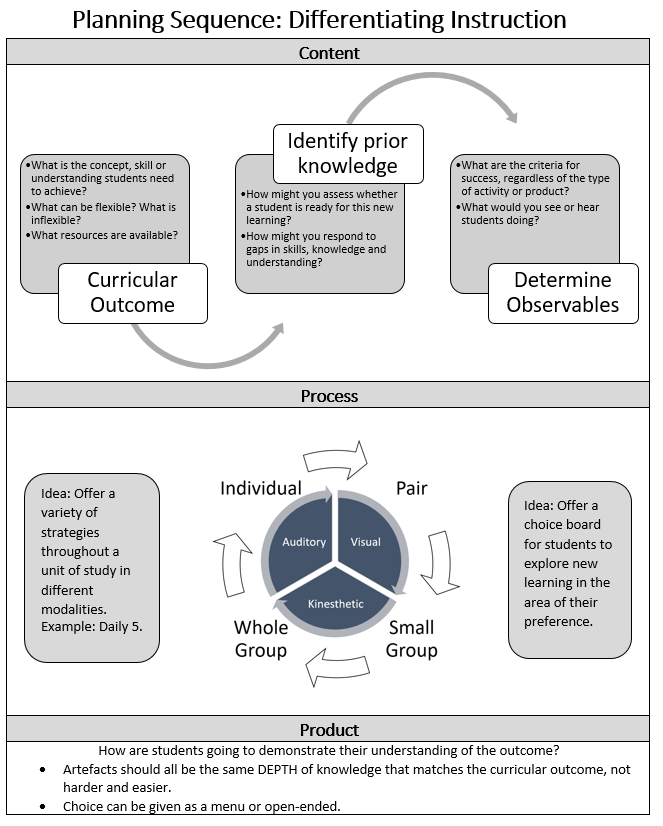
Planning Differentiation

This information can be compiled into a Learner Profile Card or a Whole-Class Preferences Summary Chart to allow both students and teachers to know what and how learners might learn best.

Something that is often an ‘aha’ for adults is to consider whether they are “Think to Talk or Talk to Think” learners. If someone is a think-to-talker and is forced to jump into group work without first having the chance to get their thoughts in order, they may have a feeling of being unsafe expressing their ideas. If a talk-to-thinker is forced to read quietly before they are allowed to talk, they may find that their minds wander and are unable to focus. This same sense of safety is true for student learners as well.

One of the foundational researchers in the area of differentiation is Carol Tomlinson, who describes differentiation as

  1. Being curious about our students,
  2. Having relationships between teachers and students; and
  3. Providing a variety of learning experiences to learners
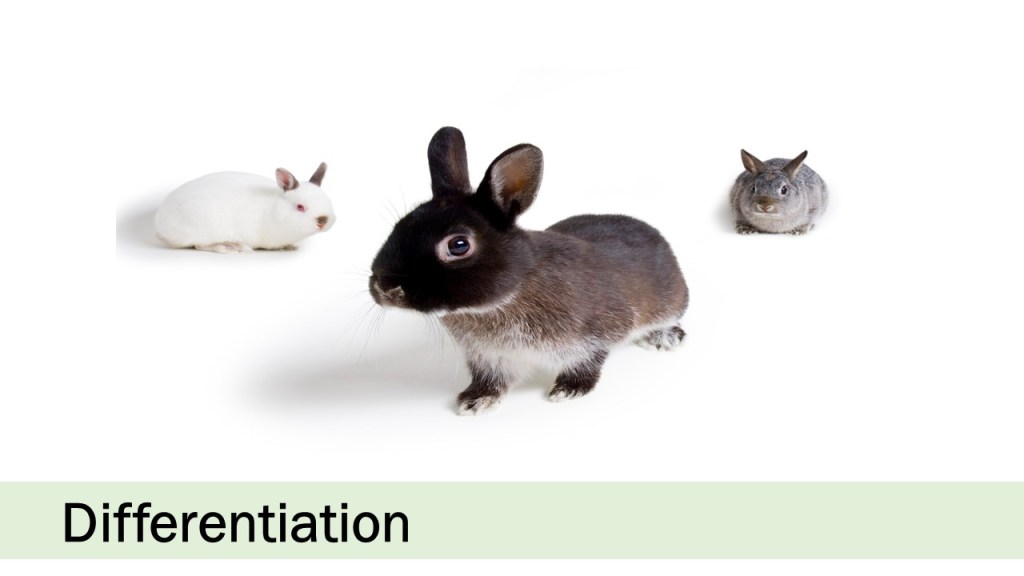
Differentiating Content

Why:

Differentiating content allows you to address gaps in understanding to build readiness. We know in literacy that activating prior knowledge is essential for students to make connections to new learning. This is true in other subjects as well. Assessing prior knowledge allows gaps to be addressed before new concepts are introduced. Differentiating content allows students to ACCESS information and learning.

What:

Your curriculum drives the knowledge, concepts, skills, and understandings a student needs to know and use. While the curricular outcome cannot change for individual students, the delivery format for content such as video, readings, audio, reading level can be differentiated. Content can also be chunked, shared through visual graphic organizers, or addressed through jigsaws to reduce the volume of information each individual needs to interact with. Themes can be based on personal interest to increase interest and understanding if a specific topic is not required by the curriculum.

How:

  • Use pre-assessment to determine where students need to begin, then match students with appropriate activities. Pre-assessments may include:
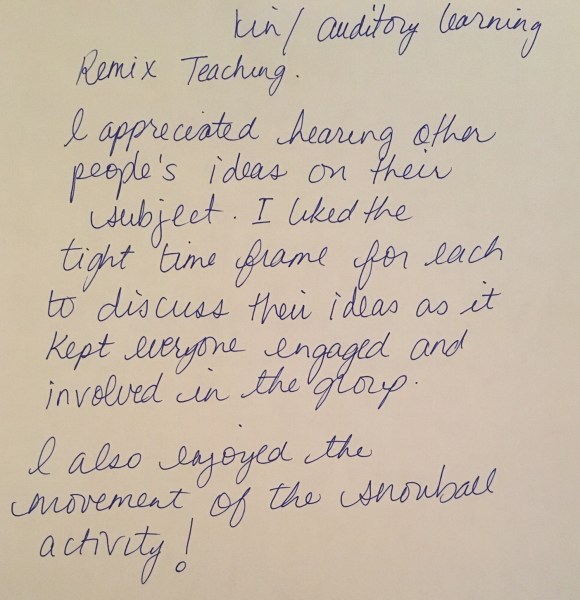
    Pciture Feedback 4
    • Student/teacher discussion,
    • Begin a KWL chart – what we know/want to know/learned,
    • Journal – what you already know about,
    • Brain dump – list all of the things you know about a topic, cluster with other class members, and
    • Snowball.
  • Use texts or novels at more than one reading level.
  • Present information through both whole-to-part and part-to-whole.
  • Use a variety of reading-buddy arrangements to support and challenge students when working with different texts.
  • Re-teach students pre-skills or provide enrichment for students who already demonstrate an understanding of pre-skills.
  • Use texts, video or different media to convey information.
  • Use Bloom’s taxonomy or Webb’s depth of knowledge to encourage thinking about content at several levels.

Differentiation Process

Why:

Differentiating process is about how students make sense of new learning. What is happening in each individual brain is based on their learning preferences, multiple intelligences, and background. Learners need time to take in, reflect on and make sense of new learning before moving on. Processes help students monitor their comprehension and determine what they do and do not understand. Learning processes also allow teachers to formatively assess student progress and provide feedback in real time.

What:

There are many different words used to describe learning processes – instructional strategies, discursive strategies, comprehension strategies… all of these are ways that learners interact with and make sense of new learning. Providing more or less structured support for learning, planning for a variety of instructional strategies based on the variety of learning styles in a classroom during a unit of study, and providing opportunities for self-reflection and self-assessment, and providing individual, pair/small group and whole group learning experiences are some key ideas for differentiation process.

How:

  • Assess learning styles, multiple intelligences, learning preferences, etc. to understand individual learning profiles as well as your class profile.
  • Use tiered activities that allow all students to work on the same outcome but with different levels of support.
  • Provide different learning experiences based on interests – i.e. when exploring mixtures and solutions, some students might choose to learn concepts through cooking, while others may learn concepts through art.
  • When planning a unit of study, ensure that concepts are interacted with using a variety of modes. For example, in mathematics, a planning form for math could be based on the idea of multiple representations of mathematical ideas:

Math Example Differentiation
  • Use a variety of comprehension strategy tactics.
  • Provide choice for students for how they are going to take notes, summarize information, make connections.
  • Use reflective strategies, such as:
  • Literature Circles(which also support content and product differentiation).
  • Different classroom structures, such as stations/centers, choice boards, flexible grouping all allow for different processes to be occurring simultaneously.

Differentiating Product

Why:

Differentiating product allows for student choice and allows learners to use their strengths to represent their understanding. Product choices all align to curricular outcomes, so learning is not compromised. Student voice and choice increase learner engagement. Products are the way that students represent their thinking about a curricular outcome. Differentiating the type of product being created allows you to see what they know about the curricular topic rather than the skill they needed to package that representation.

What:

Product differentiation is often cited as the most common form of differentiation and is often in the form of choices. You as the teacher may provide those choices and students pick from a variety of formats, you may have students propose their own designs or a combination of the two. How much responsibility and autonomy you provide for your students will depend on factors such as student understanding of their own strengths, age and time. When providing choice, it is important to co-construct clear criteria for success so that all products, regardless of form, are all being assessed on curricular outcomes rather than the form of a product. A rule of thumb is that the same checklist/rubric/assessment tool should be able to be used for all products on the same outcome, whether they are a paper, video, play, board game, etc.

How:

  • Allow students to help design product choices.
  • Co-construct assessment criteria.
  • Allow for varied working arrangements – individual, pair, group
  • Provide for or encourage students accessing a variety of resources.
  • Ensure that all products are at the same level of Bloom’s Taxonomy or Webb’s Depth of Knowledge.
  • Use a common assessment tool (checklist, rubric, etc.).

Conclusion:

When teachers plan by connecting content, process, product and learning product with student readiness, interests and learning profiles, students are more engaged and are able to understand ideas with a higher level of complexity.

Works Cited

McCarthy, J. (2015, August 28). 3 Ways to Plan for Diverse Learners. Retrieved from Edutopia: https://www.edutopia.org/blog/differentiated-instruction-ways-to-plan-john-mccarthy

New South Wales Education. (2015). Decide What to Differentiate. Retrieved from Phase 4 – Differentiating Learning: http://www.ssgt.nsw.edu.au/differentiating_learning.htm

Teaching Number Operations

Addition, subtraction, multiplication and division are foundational skills that are applied to many mathematical concepts. Often, when we are hoping for student automaticity and fluency in numbers, number operations are what we are talking about.

Mathematical Models

Models are the way we are representing numbers so that we can do number operations. There are a number of different models that are helpful to students understanding number operations.

Models that Emphasize 10

Models that Emphasize Place Value

Models that Emphasize Patterns

Models that Emphasize Partitioning Number

The Importance of Partitioning Numbers

Regardless of what number operation we are talking about, it is important that children are able to break numbers into parts.

Friendly Numbers – children are often able to understand number operations with ‘friendly’ numbers like 2, 5, and 10. Breaking a 7 into a  and a 2 allows us to use number facts that are more familiar.

Place Value Partitioning – when we are working with multi-digit numbers, it is helpful for us to break numbers up into the values of their digits – for example, 327 is 300 + 20 + 7.

Number Operation Strategies

There are many different strategies that children use to perform number operations. A misconception is that all children need to know and use all strategies. It is important for us to expose children to different strategies through classroom discussion and routines such as number talks and number strings. When combined with Margaret Smith’s ideas around Orchestrating Classroom Discussion, we can set a task for students and

  1. Predict what strategies they might use. Order these from least to most complex.
  2. Observe students doing mathematical tasks – using white boards allows us to see their thinking. We can then identify different strategies being used.
  3. Have students share their thinking in an order from least to most complex. This should not include every child sharing for every task. A small handful of children sharing in a logical order can help students understand the next more complex solution. In this way, children are being exposed to other strategies, will be able to understand those that are close to their own, and increase the sophistication of their thinking.
Strategies Connection to Addition Connection to Multiplication
Counting: This is a common strategy when one of the numbers is small. Addition by counting or counting on from one number. Ex: 25 + 7 = 25, 26, 27, 28, 29, 30, 31, 32.   Skip counting by one of the numbers being multiplied. 9 x 5 = 9, 18, 27, 36, 45  
Decomposing Numbers: breaking numbers apart. Adding friendly numbers. Ex: when you need to add 12, breaking it into +10 and then +2 more.  

Making 10. Ex: when adding 5 + 7, recognizing that 5 + 5 = 10, and so it is 10 + 2 more = 12.  

Breaking one or both numbers into place value. Ex: 23 + 47 is 20 + 40; 3 + 7
Multiplying friendly numbers. Ex: when you need to multiply by 6, break it into x 5 and 1 more.          


Partial Products: Breaking one or both numbers into place value. Ex: 23 x 47 is (20 + 3) x (40 + 7)
Compensation: this is very common when a number is close to 10. Rounding one of the numbers to a friendly number, then compensating the answer at the end for the difference. Ex: 36 + 9 is close to 36 + 10, subtract 1. Ex: 36 + 11 is close to 36 + 10, add 1. Rounding one of the numbers to a friendly number, then compensating the answer at the end for the difference. Ex: 99 x 5 is close to 100 x 5, subtract 5 Ex: 101 x 5 is close to 100 x , add 5
Double/Half Recognizing that 4 + 4 is double 4, or 8. Recognizing that 4 + 3 is almost double 4, subtract 1. Recognizing that 5 x a number is the same as ½ of 10 x a number. Ex: 9 x 5 is half of 9 x 10 = 45
Standard Algorithm Traditional algorithm, symbolic regrouping. Traditional algorithm, symbolic regrouping.

A Bridge between Addition and Multiplication: Doubles

  • Doubles are one way to think about adding a number to itself, as well as the start to multiplicative thinking.
  • Doubles are an important bridge between adding and multiplication.
  • You can read more about teaching doubles here.

Addition and Subtraction

Addition is the bringing together of two or more numbers, or quantities to make a new total.

Sometimes, when we add numbers, the total in a given place value is more than 10. This means that we need to regroup, or carry, a digit to the next place. There is a great explanation of regrouping for addition and subtraction on Study.com.

Subtraction is the opposite operation to addition. For each set of three numbers, there are two subtraction and one addition number facts. These are called fact families. For example:

For the numbers 7, 3, 10:

                7 + 3 = 10

                10 – 3 = 7

                10 – 7 = 3

Fact families can be practiced using Number bonds or Missing Part cards.

As we move from single digit to multi-digit addition and subtraction, it is important that we maintain place value, and continue to move through the concrete to abstract continuum.

A helpful progression for teaching addition and subtraction can be found on the Math Smarts site.

Multiplication and Division

Conceptual Structures for Multiplication

Repeated Addition

  • This is the first structure that we introduce children to.
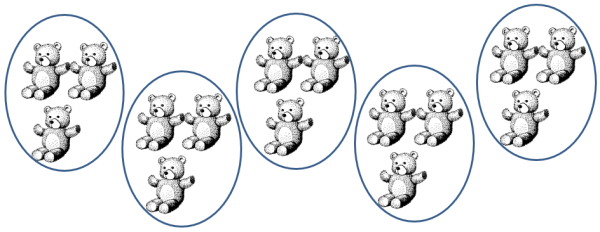
  • It builds on the understanding of addition but in the context of equal sized groups.

Rectangular Array/Area Model

  • This is often the second representation of multiplication introduced It is useful to show the commutative property that 3 x 4 = 4 x 3 = 12

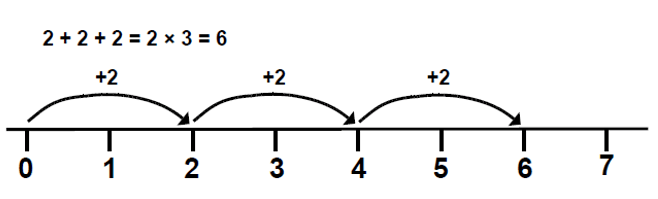
Number Line

  • A number line can represent skip counting visually.

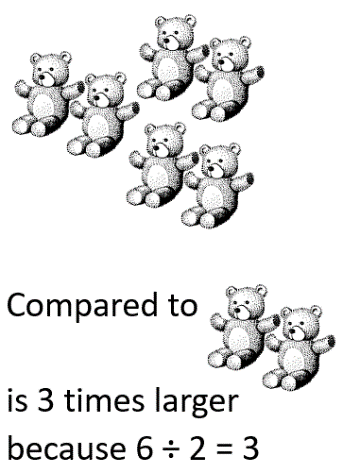
Scaling

  • Scaling is the most abstract structure, as it cannot be understood through counting.
  • Scaling is frequently used in everyday life when comparing quantities or measuring.

Single Digit Multiplication Facts

Multiplication facts should be introduced and mastered by relating to existing knowledge. If students are stuck in a ‘counting’ stage – either by ones or skip-counting to know their single-digit multiplication facts, it is important that they understand strategies beyond counting before they practice. Counting is a dangerous stage for students, as they can get stuck in this inefficient and often inaccurate stage. Students should not move to multi-digit multiplication before they understand multiplication strategies for single-digit multiplication.

  • It is important that students understand the commutative property 2 x 4 = 8 and 4 x 2 = 8.
  • 2 x 4 should be related to the addition fact 4 + 4 = 8, or double 4.
  • Using a multiplication table as a visual structure is helpful to see patterns in multiplication facts.

Mental Strategies Continuum

  • Same as (1 facts)
  • Doubles. (2 facts)
  • Doubles and 1 more (3 facts)
  • Double Doubles (4 facts)
  • Tens and fives (10, 5 facts)
  • Relating to tens (9 facts)
  • Remaining facts (6, 7, 8 facts)

Conceptual Structures for Division

Equal Grouping

In an equal grouping (quotition) question, the total number are known, and the size of each group is known.

  • The unknown is how many groups there are.

Equal Sharing

In an equal sharing (partition) question, the total number are known, and the number of groups is known.

  • The unknown is how many are in each group.

Number Line

Ratio

This is a comparison of the scale of two quantities and is often referred to as scale factor. This is a difficult concept as you can’t subtract to find the ratio.

Division Facts

Relate division facts back to multiplication facts families:

Ex)          6 x 8 = 48

                                8 x 6 = 48

                                48 ÷ 6 = 8

                                48 ÷ 8 = 6

Once students have understanding and fluency with single digit multiplication and division fact families they are ready to move on to multi-digit fact families.

So What do Students DO with Number Operations?

Simple computation is not enough for children to experience. They need to have opportunities to explore and wonder about numbers and how they work together. Regardless of the routine or task, children should be encouraged to use different concrete and pictorial models to show their thinking.

Some examples of rich interactions include:

Number Talks

  • Number talks promote classroom discussion. Combining number talks with visual or concrete models can help us see what students are thinking.

Number Strings

  • Number strings can help children see the pattern in number operations. They are helpful for children to see the pattern in number operations, which is the foundation for algebraic thinking.
  • You can see the structure for building number strings here.

SPLAT

  • SPLAT encourages both additive thinking and subitizing. More complex SPLAT lessons are also great for encouraging algebraic thinking with unknowns.

Problem Stories

  • Building problem stories are powerful for children to understand contexts of mathematics in their every day life.
  • Using real objects or pictures encourages children to see math in their environments.

Invitations

Games and Puzzles

  • There are so many games and puzzles that can have children play with number operations.

Open Middle Problems

  • Open middle problems allow for flexible thinking and exploration. You can see a sample here.

Teaching Patterns in Early Years

Patterns are everywhere. Exploring and identifying patterns can help children understand our number system, operations, spatial understanding and the foundations of algebra. Mathematics is the study of patterns and exploring them through play can begin mathematical and algebraic thinking in early years. Click here for a downloadable version of this post.

There are several big ideas related to patterns:

  1. Patterns exist and occur regularly in the natural and man-made world.
  2. Patterns can be recognized, extended and generalized using words and symbols.
  3. The same pattern can be found in many different forms – physical objects, sounds, movements and symbols.

The progression of patterns through Saskatchewan Curricula:

When viewing patterns, it is useful to know the following terms:

  • Element – an action, object, sound or symbol that is part of a sequence.
  • Core – the shortest string of elements that repeats.
  • Pattern – a sequence of elements that has a repeating core.

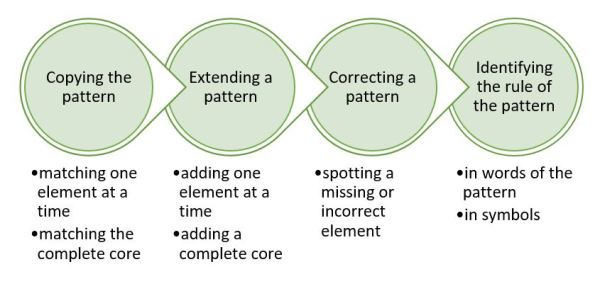
Children will develop their ability to recognize and manipulate patterns differently. Some children will move through the following progression:

Exploring patterns also gives children practice and exposure to other mathematical ideas, including:

  • Counting and cardinality – counting the number of items in the unit of a repeating pattern, or how many items are added in an increasing pattern.
  • Adding and subtracting – generalizing about an increasing or decreasing pattern – how many more or less.
  • Position and spatial properties – which element comes next, which element is between two others, reversing order of elements.

How might you teach patterns?

As with many mathematical ideas in early years, it is important to connect ideas. Learning is not linear! It is important that children use physical materials from their environment to build and explore patterns rather than relying on drawing and colouring patterns. Buttons, toys, linking cubes and natural materials can all be used to create patterns.

The Measured Mom has a list of fun ways to engage young children in exploring patterns. It is fun to take children outside. Megan Zeni describes how you might have children explore Patterns Outside and in Nature.  

Repeating Patterns

Repeating patterns can be introduced using concrete objects, sounds, body movements or symbols. Exploring with a variety of materials can help children identify what is creating a pattern.

Pattern Strips can be made using any shape or object. Students can work independently or in groups to copy the pattern on a strip using real objects. These patterns can then be extended. Watch whether they are copying each element separately or if they have identified the core of the pattern and are able to place all of the elements of the core at the same time. This might look like:

  • If the pattern is red/blue/red/blue – children will place the red and blue at the same time.

A significant step in understanding patterns is when children are able to identify that the same pattern exists even when the materials are different. Using some type of symbol, children are able to code a pattern and compare it to other patterns. If they choose to code the pattern using the alphabet, they might describe it as A-B-A-B or A-A-B-A-A-B. An extension with pattern strips is to create the same pattern with different materials.

Pattern Match can happen in many forms.

  • You can give each group a set of different pattern strips, and they find which strips are showing the same pattern.
  • Children can work in groups, one child is the pattern caller. They choose 3-4 pattern strips and lay them face up on their table. They then ‘secretly’ choose one of the strips and calls out the pattern code. Their group members try to identify which strip is being read.

Growing Patterns

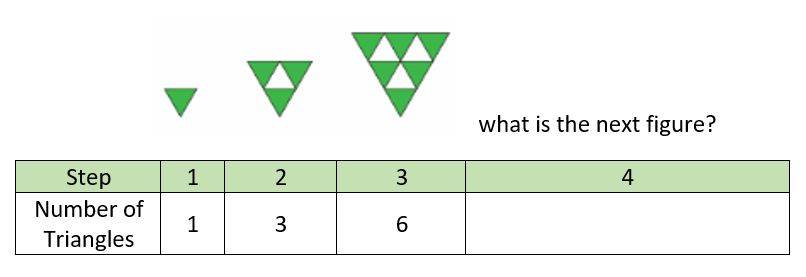
In Saskatchewan, children begin to explore increasing patterns in grade 2, and decreasing patterns starting in grade 3.  The beginning of understanding growing patterns is for children to experience building them with concrete objects.

It is important for children to record their observations. A table can help students record the number for each step in the pattern. Using a table, students can predict how many items are needed to create a certain step in the pattern.

Patterns with Numbers

Number patterns are woven throughout our number system, how we perform operations and the ways we represent numbers. John Van de Walle and LouAnn H. Lovin (Teaching Student-Centered Mathematics K-3, 2006) have created a number pattern activity that has students identify how a number string continues by identifying the pattern present.

Rectangle: Rounded Corners: What’s Next and Why?
Show students five or six numbers from a number pattern. The task for students is to extend the pattern for several more numbers and to explain the rule for generating the pattern. The difficulty of the task depends on the number pattern and the familiarity of students with searching for patterns. Here is a short list of patterns, some easy enough for Kindergarten.
1, 2, 1, 2, 1, 2, …	a simple alternating number scheme
1, 2, 2, 3, 3, 3, …	each digit repeats according to its value
5, 1, 5, 2, 5, 3, …	the courting sequence is interspersed with 5s
2, 4, 6, 8, 10, …	even numbers, skip counting by 2s
1, 2, 4, 5, 7, 8, 10, …	two counts, then skip one
2, 5, 11, 23, ….	double the previous number and add 1
1, 2, 4, 7, 11, 16, ….	the number being added increases by 1
2, 12, 22,32, …	add 10
Most of the preceding examples also have variations you can try. Make your own! (Van de Walle & Lovin, 2006)

Skip Counting

Skip counting is an excellent source of patterns. We often limit skip counting to small numbers like 2, 3 or 5. We also often start skip counting at 0. Children can explore the patterns that are created when we skip count by larger numbers, changing the start number. It is a great idea to use a calculator, so students don’t get bogged down in computation!

  • If we start at 7 and skip count by 5’s, what pattern do we see?
    • 7, 12, 17, 22, 27, 32…
  • If we start at 7 and skip count by 55’s, what pattern do we see?
    • 7, 62, 117, 172, 227, 282, 337, …
  • What do we notice about these two patterns?

Patterns in the Hundreds Chart

Start and Jump on the 100s Chart

Using a hundreds chart, have students colour in the pattern created by one of the Start and Jump Numbers sequences given. If different students represent different patterns, what do they notice?

  • How do patterns change when
    • the start number changes?
    • The jump number changes?
  • Which skip count numbers create columns?

Let’s Build the 100’s Chart

  • Using a pocket 100s chart or interactive 100’s chart. Place the following number cards in the pockets:
    • 4, 10, 17, 32, 48
  • Gather students so they can see the 100’s chart easily.
  • Hold up a number related to one of those in the chart, such as 18. Ask “who would like to place this number?”. Explain how you know where to put it.
  • Choose numbers to place based on the number concepts you are working on:
    • If you are working on adding 10, choose numbers that emphasize that concept.
    • If you are working on skip counting, choose numbers that emphasize what you are counting by.

Game: Arrow Clues

  • Clues can be created on cards or written large enough for all players to play the same clues.
  • Arrow clues can look like:
  • undefined
  • Differentiation:
    • Students can play with or without a 100s chart to refer to.
  • Have students describe the impact of each of the types of arrows on the VALUE of the number.

Missing Number Puzzles

Using the patterns in the 100’s chart, children can figure out the missing numbers when only a part of the 100s chart is provided.

Teaching Place Value

Place value and number sense are foundational concepts on which others build over the years in mathematics. Some of the big ideas within place value include:

Concept Progression Over Time

In Saskatchewan, our curriculum identifies the following ideas:

  • In Kindergarten, children learn that counting tells us how many. The whole numbers are in a particular order and there are patterns in the way we say them that help us remember their order.
  • In Grade 1, children understand place value in individual numbers – they look at 17 as a quantity. We can compare and order numbers.
  • In Grade 2, children understand that the value of the digit depends on its location or place.
  • In Grade 3, children consolidate their understanding that the place determines a number’s value.

Ideas for Teaching Place Value

Rekenreks, 5 and 10 Frames

Number sense is a foundation of place value. Relating numbers to ‘friendly’ 5 and 10 are key ideas that can move children past counting.

Try This – Use a rekenrek to show the following:

  1. Representing numbers – how might children use these tools to represent 7? 3? How do they know?
  2. Quick flash – flash a number of beads on a rekenrek and have children tell you what the number is. How do they know this is the number? Are they counting? Or comparing to the ‘friendly’ 5 or 10?
  3. Model numbers in a number string – showing 4, then 5, then 6. Some children will see the pattern of 1 less than 5, 5, and 1 more than 5. You can then repeat with 3, 5, and 7.

Now try to think through these activities using 5 and 10 Frames and linking cubes to show numbers. How is this the same and different than using a rekenrek? There are a number of games and activities involving dot cards and 10 frames that can emphasize 10.

You can find out more on the Building Math Minds Rekenrek activities site.

Subitizing

Subitizing is a foundational skill and occurs when children know that a number of objects is present without counting. Subitizing can occur with random displays of objects or dots, or patterned dots like you would see on a dice, dominoes or ten frames.

Try ThisBuilding Math Minds has a great site for subitizing games. You can find some ideas in this Evergreen Games Overview.

100s Chart

The hundreds chart is an important tool for children to see patterns in our number system. There are a number of games and activities that you can try to emphasize different math ideas.

Try This – There are a number of blogs and vlogs that teachers have created to highlight the 100’s chart. Buggy and Buddy does a good job curating ideas from a number of sources. You can also have children try to find the missing numbers on a 100’s chart to emphasize the patterns in our number system.

Base 10 Blocks

Based 10 blocks are a foundational manipulative to help children understand our number system.

Try This – Go to Hand2Mind website and scroll down to view the lessons provided. These are organized by grade band so that you can find what might fit your students best. Use the base 10 blocks provided to try to work through some of these lessons

Place Value Misconceptions

Misconceptions can be created by a mis-applied pattern, or incomplete understanding of number concepts. The following are some place value misconceptions that occur in Early Years, and some possible instructional strategies to address them.

Misconception: A number is a number, and does not represent a bundle of 10, 100, 1000 etc. objects regardless of its position in a number.

Example: 1 means one, so when it is placed in a number 17, it still represents one rather than 10.

What to do about it? Use the concrete to abstract continuum to represent 17:

  1. Place value blocks or other counters, such as coffee stir sticks.
  2. Arrow Cards
  3. Find the digit on the 100’s chart

Misconception: Students represent numbers after 100 as they sound.

Example: Students think that the number after 100 is 1001, then 1002, 1003, etc.

What to do about it: Use a chart that goes beyond 100, have children fill in the next numbers after 100.

Misconception: The student orders numbers based on the value of the digits, instead of place value.

Example: 67>103 because 6 and 7 are bigger than 1 and 2.

What to do about it: Have students represent numbers using base 10 blocks and then write out expressions using > and < when comparing.

What to do about it: Have students show numbers on a number line to see which numbers are further from zero to the right.

Misconception: The student struggles with the teen numbers, as they are different from the pattern in other decades.

Example: Students may say “eleventeen” or may not understand that 16 is ten and six. They may also think that sixteen is 61 because we say the number six first.

What to do about it: Christina, The Recovering Traditionalist, has curated a number of games and ideas for addressing how to teach the teens.

Having Fun with Math

Mathematics should be playful, and there are a number of games that can build fluency in mathematics.

Combo-10

This game allows students to see how numbers fit together to make 10 using domino-like game pieces. It is for groups of 2 – 4 players.

Try This – Play with at least two people or groups. Each group needs 1 set of dominoes. Lay them face down. Each person/group draws 7. The rest are the draw pile.

  • The player with the highest double (or most dots if there are no doubles drawn) plays first. A piece can be played if the number of dots on one side of the domino adds to 10 with a domino on the table. Doubles can be laid sideways, allowing more arms to grow.
  • A wild card is a domino whose dots add to 10. If you play a wild card, you can play twice.

Snap

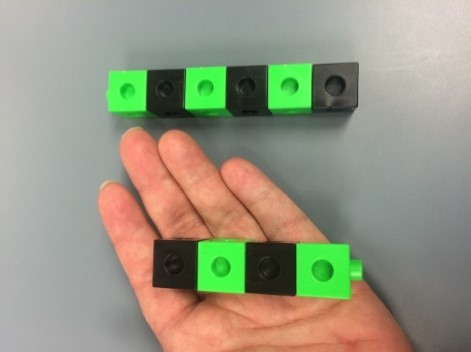
Snap is a game played with linking cubes. Each pair receives 10 linking cubes. Players may want to start with the cubes in a stack, alternating colours:

Try This – One player has a stack of 10 cubes behind their back. ‘Snap off’ part of the stack and show the part that is remaining to your partner.

The partner tries to guess how many were snapped off and hidden from view. The unknown part is revealed.

Variations:

  • Using more or fewer blocks in the stack.
  • Breaking the 10 cubes apart and hiding some of them underneath an opaque glass or container.

Race to 100

The goal of this game is to get to 100 first without going over.

Try This – Play the Game

Each player starts at 1. The first player uses a spinner or dice to generate a number. They can move up the 100s chart by their number of tens or ones until one player gets to 100 without going first.

Variations:

  • Each player gets 6 turns. The closest to 100 without going over wins.
  • Continue playing until a player lands exactly on 100. If the roll takes them over 100, they lose that turn.

Math Swat

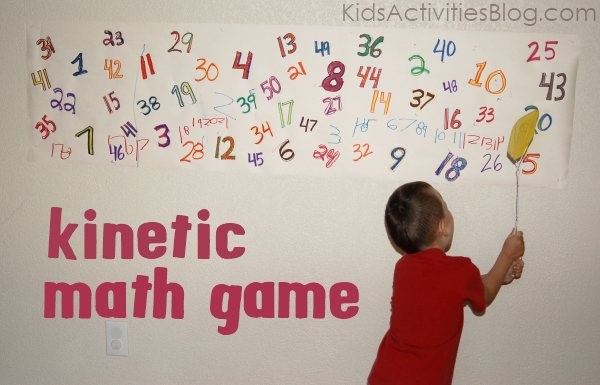
Adapted from https://kidsactivitiesblog.com/

cool math game

Flyswatter math combines the fun of moving and slapping with the chance to learn number recognition and solving math problems.

Creating the game board: The game board can be as small or as large as you would like and include the number range and type of numbers that you are working with in your classroom.

Try This – Play a Game with two lines of players. Each line has their own swatter.

  • Counting: swat the numbers in order – in either direction.
  • Number recognition: say the number and have learners swat the correct symbol.
  • Counting and 1:1 correspondence: give a number of counters, blocks, etc – they count and then swat the number.
  • Addition or subtraction facts: give the fact, swat the correct sum.
  • Addition facts: give the sum and one addend, swat the missing part.
  • Skip counting: swat the numbers as they count by 2s, 5s, etc.

Using Technology in Mathematics

Technology can be used to enhance mathematics in a number of different ways:

Place Value Online Games

As you know, not all online games are created equally! Sometimes, they are just online worksheet with little engagement. Sheppard Software is a site that encourage practice through play, including flexible thinking about place value.

Try This – Try playing one of the place value games, Underline Digit Value, on Sheppard Software.

Interactive Whiteboards

These whiteboards all allow you and students to share thinking. They can include audio, pictures, and mark ups. Some apps are free, while others require a subscription.

Try This – Log into one of the interactive whiteboards below that you have not used before. Use the username and password provided on the sticky note!

Interactive Manipulatives  – ICT Math

These interactive manipulatives can be used to explore math ideas. These tools are web-based and do not require a log in or download.

Try This – Go to the Arrow Cards tool in the “Teaching Tools” at ICT Math. You can show the value of numbers using arrow cards along with either rek-n-reks or base 10 blocks simultaneously. Show the value for 3299. What happens when you add one more ones digit?

QR Code Scavenger Hunt

This teaching idea comes from Kristin Kennedy and is available free on Teachers Pay Teachers. It would be relatively easy to create your own based on this idea.

Planning for Outcomes-Based Assessment

Outcomes-Based Assessment (OBA) has been on our educator radar for years. I have the pleasure of working with groups of teachers throughout Saskatchewan to dig into what we know, what we wonder about and examine logistical barriers or problems to solve in order to move forward.

What do teachers know? What do teachers wonder about?

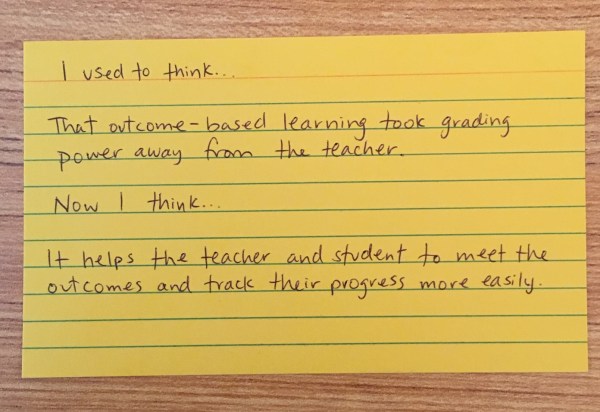
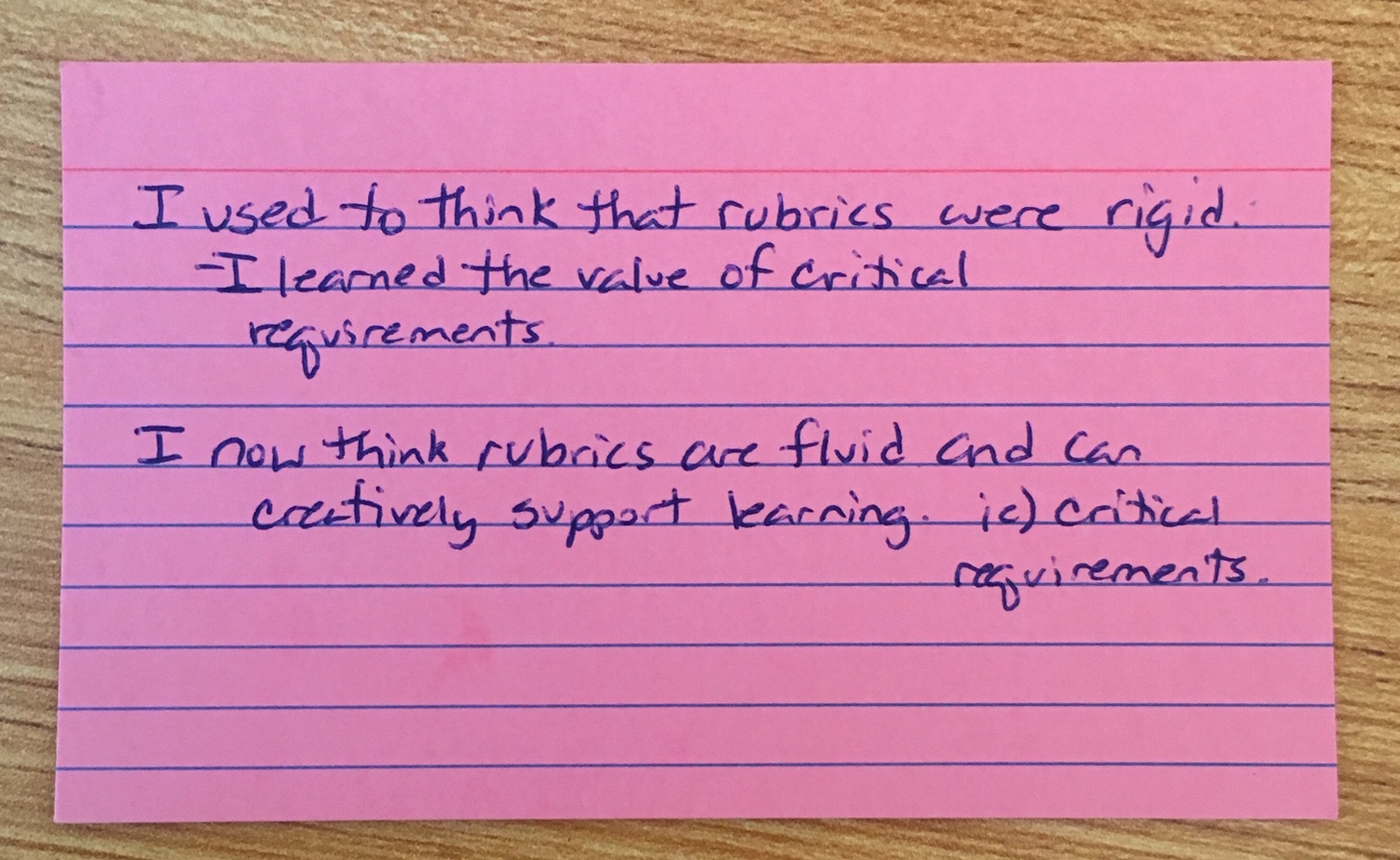
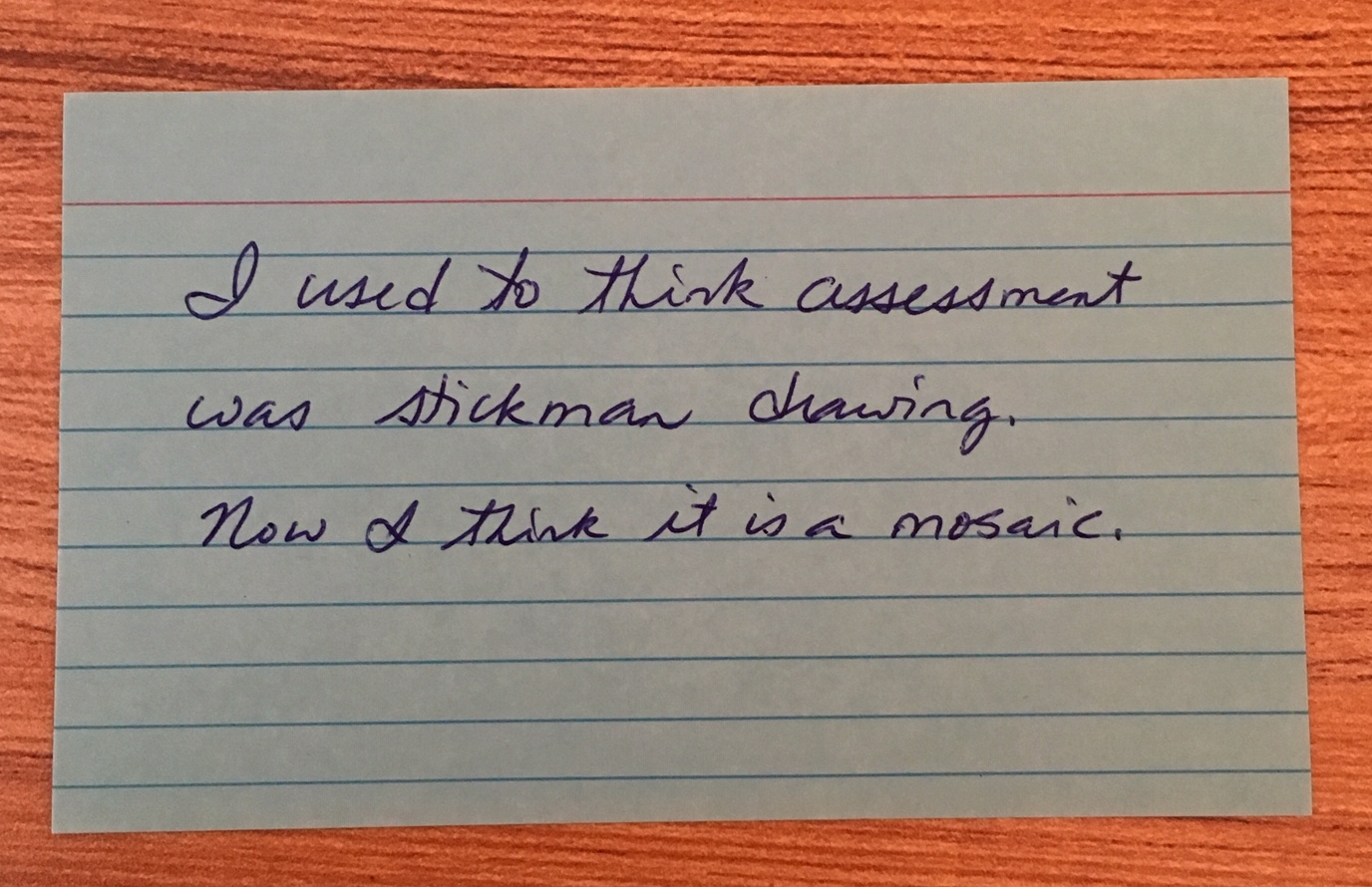
Used to Know I ThinkProfessional development needs to surface teacher knowledge, including any misconceptions that might exist. Too often, professional learning facilitators assume that educators do not know anything so begin from the beginning… or assume that educators know everything and are choosing to resist change. I would argue teachers know a lot… and they, as a collective, want to do best for students and learning. Just like in a classroom, misconstruction of knowledge can occur. It is our job as learning facilitators to use our formative assessment skills to expose understanding and misunderstanding so that we know what to do next.

When teachers are asked, What do you know about Outcomes-Based Assessment? Their answers might be similar to those generated in NLSD:

Know Complete

It is important when broad statements are made that they are clarified by the group.

  • Clarification may be needed on the term ‘learning behaviours’. These include things like attendance, behaviour, neatness, compliance with assignment expectations. Schools or systems may have other ways to communicate these ‘Hidden Curriculum’ expectations to students and parents outside of their academic achievement scores.
  • Clarification may be needed around the idea that assessment is based on “where they are at right now… can change over time”. An example where a student shows competency later in the year after that unit of study has been completed. This may raise some logistical questions around how this would work within a student information system or what impact this idea has on reporting. Once specific questions or logistical barriers surface, it is possible for a school or system to determine procedures so that they can have consistency.

As Tomas Guskey states, there is NO best practice in grading. There are ‘better’ practices that we want to embrace, but there is no universal, standardized and mechanical way to generate a grade for our students.  This was an empowering point with teachers to know that their professional judgment, based on an understanding of curricular outcomes and observable student behaviours, is the most important assessment practice. 

question mark

Along with what educators know, it is vital that we surface what they wonder about. Questions can frame teachers’ professional inquiry for a day of learning, as well as indicate what they need to be emphasized within the agenda. Typical questions around this topic may be:

  • How do I translate an outcomes-based assessment rubric into a %?
  • How do we gather, translate and score observations and conversations so that they ‘count’ like products?
  • What might a teacher daybook/unit plan look like using outcomes-based assessment?
  • Is all assessment outcome-based assessment?
  • What do we do if an assignment is late or not handed in?
  • What is the minimum/maximum number of indicators that we need to assess in order to maintain the integrity of the outcome?
  • How do we use outcome-based assessment in cross-curricular teaching?

It is important that participants choose which question(s) they are most invested in to solve, and provided time within a professional learning experience to discuss possible solutions with colleagues.

Assessment practices are founded on both beliefs and knowledge. A Talking Points Strategy can help to have small groups explore and surface their beliefs about assessment.

Starting with Curriculum

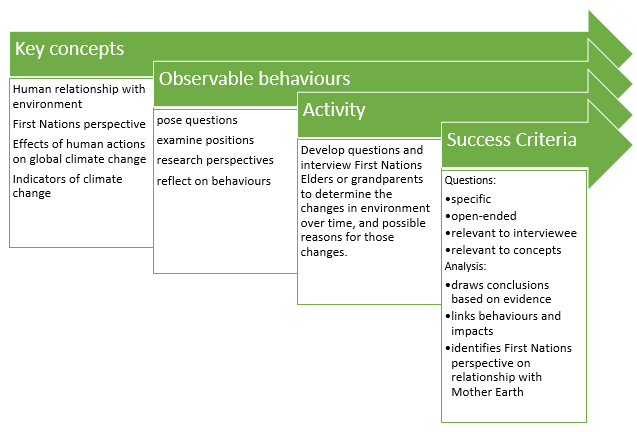
Learning targets are based on curricular outcomes. There are a number of different unit and lesson planning templates used in education. One useful process is to use a thinking map. This graphic organizer allows us to see the connections amongst curricular outcomes, instructional activities and assessment criteria.

Unpacking Outcomes

Starting in the centre, teachers can identify the connections between the nouns (concepts) and verbs (observable behaviours) of the curriculum with the activities that allow students to show those behaviours. The assessment criteria should be related to the curriculum rather than the activity.

For example, in Saskatchewan Science 10, one part of the SCI10-CD1 Outcome: Assess the implications of human actions on the local and global climate and the sustainability of ecosystems. Some of the indicators related to this outcome might be addressed in the following progression:

Outcome Unpacking

By unpacking into a circular thinking map, it is possible to see how the concepts and observable behaviours work together. This will lead to a holistic view of curriculum that eradicates the question of how many indicators are important to address.

Principles of Assessment

Rick Stiggins has developed a set of key ideas related to classroom assessment:

Stiggins Principles

(Chapuis, Commodore, Stiggins, 2016)

From Criteria to Rubrics

There are a variety of assessment tools, including checklists, portfolios, and rubrics. They all rely on clear learning targets or criteria for student success. What does success look like? What are we looking for?

Criteria Statements

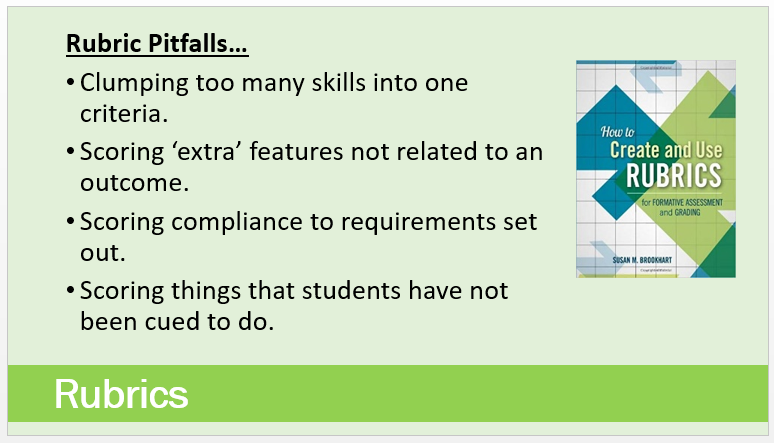
Expanding on clear learning targets, Sue Brookhart shares some of her ideas on building high-quality rubrics.

Description Statements

Rubric Pitfalls

Sue Brookhart’s ideas have been incorporated into this simple editable Rubric Worksheet.

Used to Know I Think 3

Formative and Summative Assessment

Too often, formative assessment is defined as ‘things that are not marked’, while summative assessment is defined as “things that are graded at the end of a unit”. This implies that learners can only show understanding that ‘counts’ at the end of a unit of study. So what happens to all of their thinking, work and brilliance along the way? Is it possible that a learning and assessment experience might be both or either for different students? Is it possible that formative and summative assessment are interconnected?

Definitions

One definition for assessment is the ways in which instructors gather data about their teaching and students’ learning (Northern Illinois University, Faculty Development and Instructional Design Center). This definition implies that assessment’s purpose is multi-faceted – to inform students and teachers regarding student understanding as well as to inform teachers about their practice in teaching. Assessment, whether it is formative or summative, is a snap-shot in time that changes with instruction and understanding.

Used to Know I Think 1

Formative Assessment

In his book, Embedding Formative Assessment, Dylan Wiliam defines Formative Assessment as:

“An assessment functions formatively to the extent that evidence about student achievement is elicited, interpreted, and used by teachers, learners, or their peers to make decisions about the next steps in instruction that are likely to be better, or better founded, than the decisions they would have made in the absence of that evidence” (Wiliam, 2011).

This definition implies:

  • Formative describes the function of the assessment rather than the form.
  • Teachers, students and peers might be involved in deciding how to respond to assessment information.
  • There must be a responsive action based on the data in order for the assessment to be formative. Responsive actions are instructional in nature.

If formative assessments are designed with no clear decision/action implied, then the assessment is not useful. The five key strategies for improving student achievement through formative assessment are:

Who Where the learner is going Where the learner is now How to get there
Teacher 1. Clarifying, sharing and understanding learning intentions and criteria for success. 2. Engineering effective classroom discussions, activities, and tasks that elicit evidence of learning. 3. Providing feedback that moves learning forward.
Peer 4. Activating learners as instructional resources for each other.
Learner 5. Activating learners as owners of their own learning.

(Wiliam, 2011, p. 46)

Summative Assessment

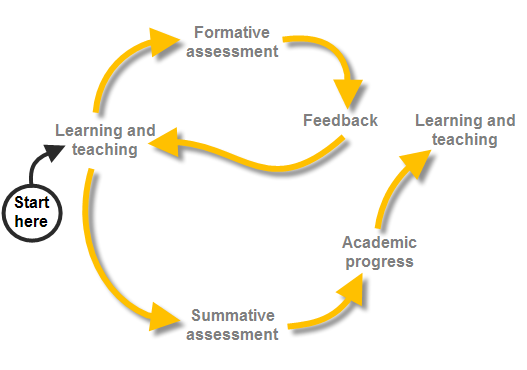
Summative assessment is often described as providing information about or evaluating the attainment of understanding or achievement compared to a standard. Katie White (Softening the Edges, 2017) has created a holistic view of summative assessment as part of a larger assessment cycle.

“We engage in formative assessment, feedback and self-assessment regularly. Only after all this do we verify proficiency with summative assessment. It is at this point that we make professional judgments about whether to re-enter the learning cycle because proficiency has not yet been reached or to transition into enrichment or the next learning goal… Viewing summative assessment as part of a larger continuous cycle frees us to make decisions that are right for our learners and right for ourselves” (White, 2017, p. 139).

Formative Summative Cycle

(The Learning and Assessment Experience at UNSW)

The goal of summative assessment is to evaluate student learning. When viewed as part of a cycle, we can see that an assessment intended to be summative may, in fact, become formative. Similarly, there may be times that an assessment intended to be formative might become summative if a learner is able to show proficiency during that experience.

If we view the terms formative and summative as how the assessment is used rather than the tool or the intent for use, it can help us to see all experiences as part of a larger assessment plan.

Used to Know I Think 2

Brookhart, S. (2013). How to Create and Use Rubrics for Formative Assessment and Grading. Alexandria: ASCD.

Chappuis, S. J., Commodore, D. C., & Stiggins, R. J. (2016). Balanced Assessment Systems: Leadership, Quality and the Role of Classroom Assessment. Thousand Oaks: Corwin.

Guskey, T. R. (2019, February 28). Let’s Give Up The Search for ‘Best Practices’ in Grading. Retrieved from Thomas R. Guskey & Associates: http://tguskey.com/lets-give-up-the-search-for-best-practices-in-grading/

UNSW Sydney. (n.d.). Guide to Assessment. Retrieved March 12, 2019, from UNSW Student Home: https://student.unsw.edu.au/assessments

White, K. (2017). Softening the Edges. Bloomington: Solution Tree.

Wiliam, D. (2011). Embedded formative assessment. Bloomington, Indiana, United States of America: Solution Tree Press.


Blog at WordPress.com.

Up ↑