What were many of us MOST looking forward to for Christmas? Food, Fun and Family… Fun in our family over the years has been board games, cards and dice games. And then new health orders came to Saskatchewan and that hope seemed to be dashed… BUT… there was a huge ‘aha’ when I was asked to design and facilitate a “Let’s Play: Math Games Online workshop” this past week. I put my research hat on and found some online platforms for play. There are SO many cool fun platforms that are FREE to everyone. There will be Cribbage for Christmas after all!!
I have always believed that my confidence and competence in math came from the games I played as a child. Cribbage with my Grandpa and Great Grandpa, Monopoly with my friend Tommy, Go Fish with my sister, 31 with my Mom and Dad… So, how might we play these games online with Jori and Michael in Martensville, Erin in Comox, and Adam in Saskatoon? And better yet, how do we play them with the kids’ cousins Paige in Halifax, Amanda and Christian in Winnipeg, and then there is Auntie Sandra in Melfort and Grandma Carol down in Mesa this Christmas? My family is FAR too large to list everyone here, but you get the idea. Here are some games and platforms that might bring some cheer to your homes and families over the holidays.
Each of the following does NOT require an account or sign in. For each, you:
Start a game.
Copy the link and send it out by text or email to your game friends.
Set up a phone call or video call so that you can talk to everyone in the game. (Did you know that your iPhone can create a group call up to 5 people??) Or use Zoom, Google Meet, Facebook Rooms, What’s App… SO many possibilities. If two of you are in the same house on your own devices, consider either using your phone on speaker, or each of you use headphones/ear buds so you don’t get sound feedback.
Each of these is designed for each player to have their own device – they seem to work on computers or tablet/iPad or smart phone.
Addition, subtraction, multiplication and division are foundational
skills that are applied to many mathematical concepts. Often, when we are hoping
for student automaticity and fluency in numbers, number operations are what we
are talking about.
Mathematical Models
Models are the way we are representing numbers so that we
can do number operations. There are a number of different models that are
helpful to students understanding number operations.
Regardless of what number operation we are talking about, it
is important that children are able to break numbers into parts.
Friendly Numbers – children are often able to understand number
operations with ‘friendly’ numbers like 2, 5, and 10. Breaking a 7 into a and a 2 allows us to use number facts that are
more familiar.
Place Value Partitioning – when we are working with multi-digit
numbers, it is helpful for us to break numbers up into the values of their
digits – for example, 327 is 300 + 20 + 7.
Number Operation Strategies
There are many different strategies that children use to
perform number operations. A misconception is that all children need to know
and use all strategies. It is important for us to expose children to different
strategies through classroom discussion and routines such as number talks and
number strings. When combined with Margaret Smith’s ideas around Orchestrating
Classroom Discussion, we can set a task for students and
Predict what strategies they might use. Order
these from least to most complex.
Observe students doing mathematical tasks –
using white boards allows us to see their thinking. We can then identify
different strategies being used.
Have students share their thinking in an order
from least to most complex. This should not include every child sharing for
every task. A small handful of children sharing in a logical order can help
students understand the next more complex solution. In this way, children are
being exposed to other strategies, will be able to understand those that are
close to their own, and increase the sophistication of their thinking.
Strategies
Connection to Addition
Connection to Multiplication
Counting: This is a common strategy when one of the numbers is small.
Addition by counting or counting on from one number. Ex: 25 + 7 = 25, 26, 27, 28, 29, 30, 31, 32.
Skip counting by one of the numbers being multiplied. 9 x 5 = 9, 18, 27, 36, 45
Decomposing Numbers: breaking numbers apart.
Adding friendly numbers. Ex: when you need to add 12, breaking it into +10 and then +2 more.
Making 10. Ex: when adding 5 + 7, recognizing that 5 + 5 = 10, and so it is 10 + 2 more = 12.
Breaking one or both numbers into place value. Ex: 23 + 47 is 20 + 40; 3 + 7
Multiplying friendly numbers. Ex: when you need to multiply by 6, break it into x 5 and 1 more.
Partial Products: Breaking one or both numbers into place value. Ex: 23 x 47 is (20 + 3) x (40 + 7)
Compensation: this is very common when a number is close to 10.
Rounding one of the numbers to a friendly number, then compensating the answer at the end for the difference. Ex: 36 + 9 is close to 36 + 10, subtract 1. Ex: 36 + 11 is close to 36 + 10, add 1.
Rounding one of the numbers to a friendly number, then compensating the answer at the end for the difference. Ex: 99 x 5 is close to 100 x 5, subtract 5 Ex: 101 x 5 is close to 100 x , add 5
Double/Half
Recognizing that 4 + 4 is double 4, or 8. Recognizing that 4 + 3 is almost double 4, subtract 1.
Recognizing that 5 x a number is the same as ½ of 10 x a number. Ex: 9 x 5 is half of 9 x 10 = 45
Standard Algorithm
Traditional algorithm, symbolic regrouping.
Traditional algorithm, symbolic regrouping.
A Bridge between Addition and Multiplication: Doubles
Doubles are one way to think about adding a number to itself, as well as the start to multiplicative thinking.
Doubles are an important bridge between adding and multiplication.
Addition is the bringing together of two or more numbers, or
quantities to make a new total.
Sometimes, when we add numbers, the total in a given place
value is more than 10. This means that we need to regroup, or carry, a digit to
the next place. There is a great explanation of regrouping for addition and
subtraction on Study.com.
Subtraction is the opposite operation to addition. For each
set of three numbers, there are two subtraction and one addition number facts.
These are called fact families. For example:
As we move from single digit to multi-digit addition and
subtraction, it is important that we maintain place value, and continue to move
through the concrete to abstract continuum.
A helpful progression for teaching addition and subtraction can be found on the Math Smarts site.
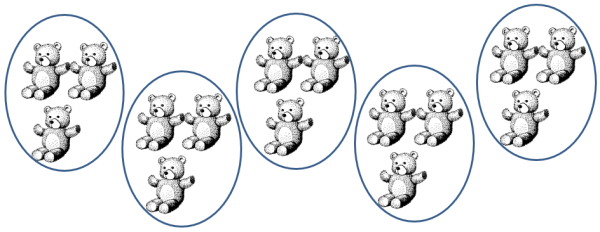
This is the first structure that we introduce
children to.
It builds on the understanding of addition but
in the context of equal sized groups.
Rectangular Array/Area Model
This is often the second representation of multiplication introduced It is useful to show the commutative property that 3 x 4 = 4 x 3 = 12
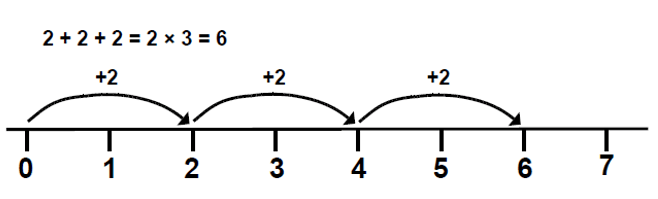
Number Line
A number line can represent skip counting
visually.
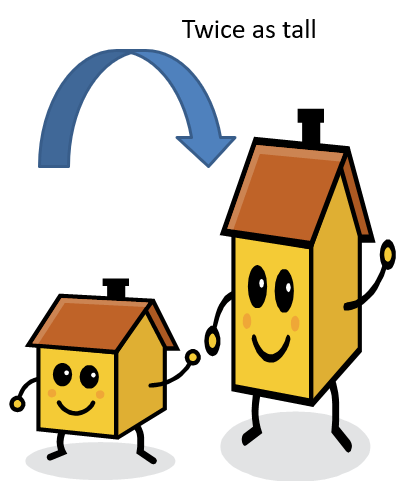
Scaling
Scaling is the most abstract structure, as it
cannot be understood through counting.
Scaling is frequently used in everyday life when
comparing quantities or measuring.
Single Digit Multiplication Facts
Multiplication facts should be introduced and mastered by
relating to existing knowledge. If students are stuck in a ‘counting’ stage –
either by ones or skip-counting to know their single-digit multiplication
facts, it is important that they understand strategies beyond counting before
they practice. Counting is a dangerous
stage for students, as they can get stuck in this inefficient and often
inaccurate stage. Students should not
move to multi-digit multiplication before they understand multiplication
strategies for single-digit multiplication.
It is important that students understand the
commutative property 2 x 4 = 8 and 4 x 2 = 8.
2 x 4 should be related to the addition fact 4 +
4 = 8, or double 4.
Using a multiplication table as a visual
structure is helpful to see patterns in multiplication facts.
In an equal grouping (quotition) question, the total number
are known, and the size of each group is known.
The
unknown is how many groups there are.
Equal Sharing
In an equal sharing (partition) question, the total number
are known, and the number of groups is known.
The
unknown is how many are in each group.
Number Line
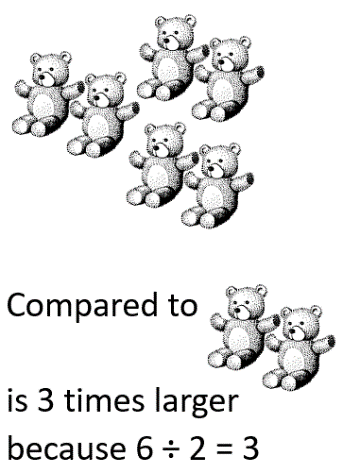
Ratio
This is a comparison of the scale of two quantities and is
often referred to as scale factor. This is a difficult concept as you can’t
subtract to find the ratio.
Division Facts
Relate division
facts back to multiplication facts families:
Ex) 6 x 8 = 48
8 x 6 = 48
48 ÷ 6 = 8
48 ÷ 8 = 6
Once students have understanding and fluency with single digit multiplication and division fact families they are ready to move on to multi-digit fact families.
So What do Students DO with Number Operations?
Simple computation is not enough for children to experience.
They need to have opportunities to explore and wonder about numbers and how
they work together. Regardless of the routine or task, children should be
encouraged to use different concrete and pictorial models to show their
thinking.
Number strings can help children see the pattern
in number operations. They are helpful for children to see the pattern in
number operations, which is the foundation for algebraic thinking.








 Terry Johanson Consulting