As math teachers, we spend much of our time planning for students who need extra time or support to understand mathematics at our grade level. We also worry about how we might create appropriate challenge for students who have a strong foundation in math and are ready to move ahead before their classmates are ready. The last thing we want is for our most able mathematics students to get bored and disengage. Enrichment seems like a good option, but how do we do that?
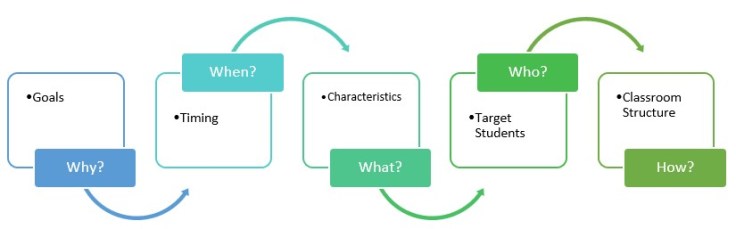
Why? Goals
Enrichment activies are meant to allow students to
engage in rich tasks and activities at grade level
stay with their peers
replace foundational math tasks that other students require to build understanding
reinforce mathematical thinking skills so that students are even more able to engage in grade-level math
When? Timing
There are at least two opportunities for enrichment within your instructional sequence.
When we pause to help students review and build readiness for grade-level instruction. This might be in the form of a concept review, reteach, or responsive station.
Enrichment tasks can be an option for students who do not need to review or practice foundational skills.
Enrichment tasks that are loosely based on the same concepts as are in the review will help students be even more ready for grade-level instruction.
When we are teaching grade-level concepts and the majority of students require more time to complete tasks.
Enrichment tasks can be an option for students who are done work earlier than their peers.
Enrichment tasks that are loosely based on the grade-level concept, but allow for creative thinking and application can allow students to see mathematics in a creative and contextual way.
What? Characteristics
Enrichment tasks take on all different forms. Some common characteristics might be:
Engaging
Hands-on
Applied to the Real World
Creative
Games
Puzzles
Math Outside of Curriculum
Connecting Math Concepts
Social Justice topics
You can access hundreds of curated resources in this Enrichment Task Google Folder. Feel free to share, download, and use these resources.
Who? Target Students
All students might be able to engage in Enrichment tasks at some point in the year. Different students have different strengths. Enrichment is not exclusive to gifted students.
How? Classroom Structures
A station or enrichment corner are relatively simple to set up. One thing to consider is what tasks to have available at what time. A suggestion is that the tasks in the enrichment station should be loosely related to the math concept being experienced by the rest of the class. This ensures that the students doing enrichment tasks are going to be even more able to complete grade-level math tasks. When enrichment tasks are completely unrelated to the math students will experience next, we are inadvertently creating a time gap in student learning and may actually contribute to lower achievement.
Our school year seems to race by faster and faster every year. A worry that we have is that our students might not be ready for their next concept, next grade, or next step in their education journey. Some of our hopes while year planning would be to:
Prioritize concepts that are foundational to the next school year.
Estimate time so that higher priority outcomes have more time.
Order concepts logically so that math ideas build within a grade.
Cluster outcomes that help kids understand the connections between math ideas.
A prioritized and sequenced math year plan is not a pacing guide. Rather, it is a roadmap that helps you, as teacher, know where you are going next, and provides an estimate for how long to spend on a concept. A prioritized and sequenced year plan should be revisited several times through the year to see where you are at, what might need to change, and what your students need next.
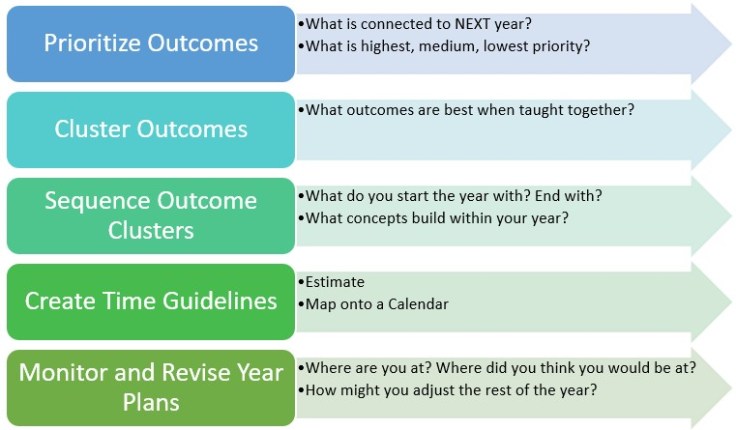
Creating a Prioritized and Sequenced Math Year Plan
Prioritize Outcomes
To prioritize outcomes in our grade level, it is important to know what concepts lead directly into next year’s math curriculum. Some tools that help you do this are Curricular Through Lines. It is most helpful to use the document that shows YOUR grade as well as the grade level after you:
Highlight outcomes YELLOW if they lead directly into next year. For example, multiples and factors in Grade 6 (N6.2) leads directly into adding and subtracting fractions (N7.5) and divisbility rules (N7.1).
Do not highlight an outcome if it does not lead directly into next year. For example, numbers greater than 1000000 in Grade 6 (N6.1) does not lead into any outcome in Grade 7.
Go back to your yellow outcomes. In a given year, you might want to have 6-7 outcomes that are highest priority (GREEN). If you have more than 6-7 outcomes highlighted yellow, which of those would be most important to emphasize? You might want to have a discussion with the next grade teacher to help you determine this.
At the end of this process, you might have:
6-7 HIGHEST priority outcomes.
some MEDIUM priority outcomes.
some LOWEST priority outcomes.
Cluster Outcomes
Some of our curricula have several outcomes that would be much more effective if they are taught together. For example, in Grade 7, there are several patterns and relations outcomes and a shape and space outcome that are easier to teach if you put them together:
P7.1 – Relationships between tables of values, graphs, and linear relations
P7.2 – Understanding equations and expressions
P7.3 – Solving one and two step equations with whole numbers
P7.4 – Solving one and two step equations with integers
SS7.4 – Ordered pairs and the Cartesian Plane
When you look at these holistically, it might make sense to cluster these outcomes into:
P7.3 and P7.4 – Solving one and two step equations
P7.1, P7.2, SS7.4 – Representing linear equations as a graph, table of values, equations, words, and pictures/manipulatives.
Once you cluster your outcomes in this way, they act as a single unit within your year plan.
Sequence Outcome Clusters
There are several things to consider when you are creating your outcome sequence:
How might you start the school year? What are they ready for after summer break?
If you follow the order of curriculum, we would begin with place value. While this might be logical at early grades, it can sometimes be daunting for students coming back after summer.
Consider starting with a topic that has lots of hands-on opportunities that can help students understand what numbers and shapes are. This will help get them ready for place value later on.
Example: Consider starting with a graphing and data outcome so that students can use numbers as they create axes for graphs and explore how big those numbers are within a real-life context.
What outcomes are pre-skills for other outcomes in your grade?
There are several examples where one outcome logically comes before another one.
Example: In grade 2, it makes sense that numbers to 100 would be taught before adding and subtracting numbers to 100.
Sometimes we might think something is a preskill that is not. For example, in grade 3 we might think that we need to do addition and subtraction before we do multiplication and division. Because multiplication in grade 3 is limited to 5 x 5, we don’t need to be able to add large numbers before we multiply. In fact, the pre-skills for multiplication are:
knowing numbers to 25.
skip counting by 2, 5.
decomposing numbers.
How might you end the school year? What is best suited for May and June instruction?
Spring is a great time to go outside and extend your classroom. When you consider what math fits into outdoor experiences, you might want to plan for those concepts in the spring.
Example: Grade 3 data and graphing could be based on finding things in the natural environment, creating concrete graphs, pictographs, tallies, and graphs representing what you find.
Create Time Guidelines
The time you spend on each topic is determined mostly by how many highest priority outcomes or outcome clusters you have identified and how many days of mathematics you have in a school year. If you have math every day, you can count on having approximately 150 days of math, as there are always concerts, field trips, and other things that impact instructional time.
Estimate the amount of time per outcome (or outcome cluster):
Highest Priority Outcome – 22 to 25 days
Lowest Priority Outcome – 2 to 5 days
Medium Priority Outcome – 5 to 10 days
Estimate the total number of days you might need for all of your prioritized outcomes.
Is this approximately equal to your instructional time?
Do you need to shorten timelines? Lengthen them?
Plot your units out onto a school year calendar.
Do outcomes begin and end at logical times? What might need to shift for holidays and report cards?
Sample Year Plans
Sample year plans are not meant to show you a ‘right’ answer, but rather to be an example of what a prioritized and sequenced year plan might look like.
It is important to revisit and revise your year plan through the year. Student needs and unexpected disruptions require adjusting along the way. Things to consider when you are reflecting on your year plan are:
Where did I think we would be in our sequence right now? Where are we actually at?
When I look ahead to the end of the year, do I need to adjust the amount of time I am spending on the units I have left?
Are there some of my prioritized outcomes that I need to deprioritize to give us time on what is MOST important?
Might I need to shift some of my lower and medium priority outcomes to stations or centers?
Are there some outcomes that I might connect to other curricula? Examples include:
Some shape and space outcomes moved to Art (transformations, area, 3D objects)
Some statistics outcomes moved to Social Studies (measures of central tendency, graphing)
It is important to keep your year plan current so that can make informed decisions throughout your year. Reflecting regularly can help you build a strong foundation for your students.
What were many of us MOST looking forward to for Christmas? Food, Fun and Family… Fun in our family over the years has been board games, cards and dice games. And then new health orders came to Saskatchewan and that hope seemed to be dashed… BUT… there was a huge ‘aha’ when I was asked to design and facilitate a “Let’s Play: Math Games Online workshop” this past week. I put my research hat on and found some online platforms for play. There are SO many cool fun platforms that are FREE to everyone. There will be Cribbage for Christmas after all!!
I have always believed that my confidence and competence in math came from the games I played as a child. Cribbage with my Grandpa and Great Grandpa, Monopoly with my friend Tommy, Go Fish with my sister, 31 with my Mom and Dad… So, how might we play these games online with Jori and Michael in Martensville, Erin in Comox, and Adam in Saskatoon? And better yet, how do we play them with the kids’ cousins Paige in Halifax, Amanda and Christian in Winnipeg, and then there is Auntie Sandra in Melfort and Grandma Carol down in Mesa this Christmas? My family is FAR too large to list everyone here, but you get the idea. Here are some games and platforms that might bring some cheer to your homes and families over the holidays.
Each of the following does NOT require an account or sign in. For each, you:
Start a game.
Copy the link and send it out by text or email to your game friends.
Set up a phone call or video call so that you can talk to everyone in the game. (Did you know that your iPhone can create a group call up to 5 people??) Or use Zoom, Google Meet, Facebook Rooms, What’s App… SO many possibilities. If two of you are in the same house on your own devices, consider either using your phone on speaker, or each of you use headphones/ear buds so you don’t get sound feedback.
Each of these is designed for each player to have their own device – they seem to work on computers or tablet/iPad or smart phone.
We have rich Saskatchewan curricula, and an important step in planning is to make sense of what curriculum is asking students to know, do, and understand, and to connect to our local context. I just recently had a chance to work with the CTEP students in Cumberland House under the guidance of their instructor Lily McKay-Carrier. She calls this Nistota Curriculum (Understand Curriculum). Place matters, our students matter, and our own professional and personal knowledge matters when planning for instruction and assessment. Our professional judgment and expertise are what helps us design units of study that honour who are where we are teaching.
We know that outcomes are what students need to know, do and understand. They are the destination of instruction, while indicators are the ways that students might show us that they know.
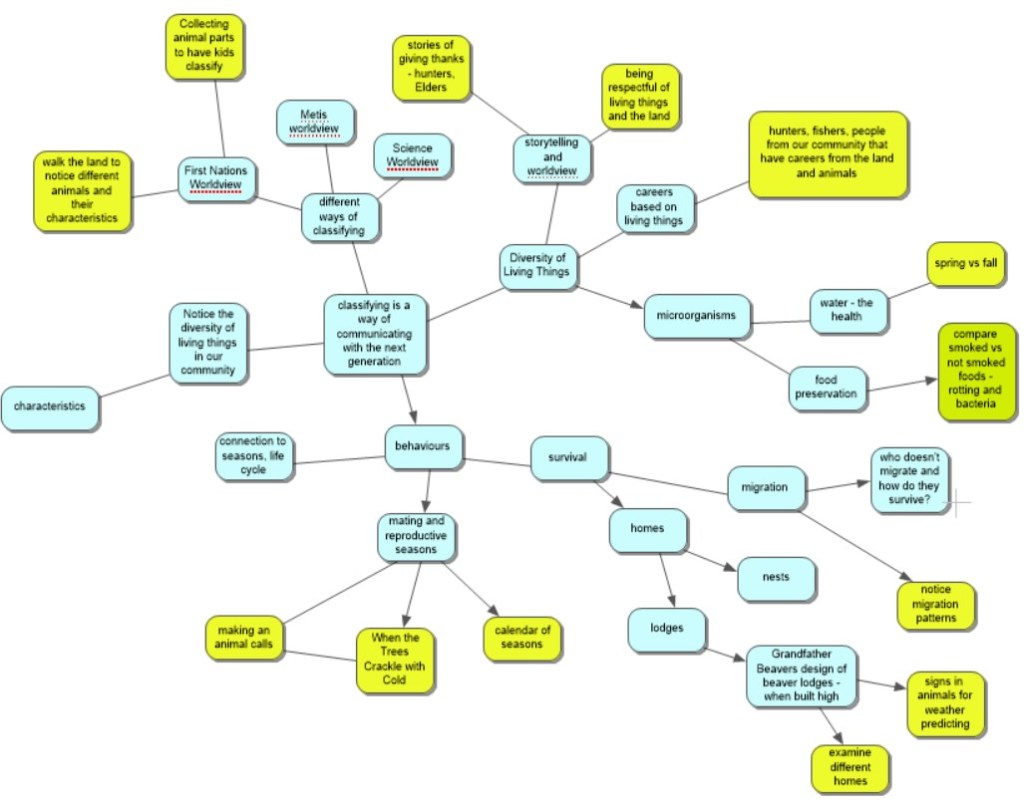
So what is a process that we might use to make sense of curriculum? Mind mapping is a visual way to see connections between curricular ideas and link to our teaching context.
Steps for Mind Mapping:
Determine what course(s) and outcome(s) you are going to cluster into one unit of study.
If you are creating a cross-curricular unit, then you might want to start with one course and then link to others.
Some curricula cluster outcomes into strands that make sense to teach as one unit (i.e. science and social studies), while others make sense to cluster outcomes from different strands or teach them alone (i.e. mathematics), as a strand is too large.
Identify what concepts students would have interacted with BEFORE this unit that would have provided a foundation, and what concepts this unit feeds into next.
Read over the outcomes to get a general sense of what the unit of study will be about. If you were to describe this unit to someone who is not a teacher, what might you say in a sentence or two?
Highlight the main concepts identified in the outcomes and indicators. These are often the NOUNS.
Mind map the main concepts to see how they connect. Often, there is repetition between outcomes, so this helps to streamline the unit.
Ask yourself what activities based on your community or your personal and professional knowledge might connect to curricular ideas. Add these to your mind map.
Sample Unit: Mind Map of Diversity of Living Things generated in collaboration with CTEP students fall, 2020.
Once you have generated teaching ideas, ask yourself if these honour the intent of the indicators in your curriculum. If a student did these things, would they be able to show that they know, do or understand this outcome?
Developing your Mind Map into a Unit of Study
Once you have created a mind map of key concepts and teaching activities, you can
develop essential questions that pull together the unit.
Develop an instructional sequence that includes:
Learning Activities
Assessment – both formative and summative
Materials/resources required
You can see the beginning of a draft unit of study created in collaboration with CTEP students in fall, 2020 focusing on Diversity of Life in Science 6.
I had the chance to work with the wonderful staff at Rossignol Elementary in Ile-a-la-Crosse this winter. They, like many of us, have been wondering how to support their students to be more engaged writers. They wondered:
How do we engage student writers? How do we make our students feel that they ARE writers and authors in our classrooms? There are so many blogs and ideas written on this topic, but what might work for OUR students?
There are many blogs and resources that are useful when seeking out new and innovative ideas to try. Some good ones include (but are certainly not limited to!):
Each of these articles is full of lists of creative strategies. But what works for YOUR students? This is where professional conversations and thinking about what students you have in your context can help.
We often ponder the question “Why don’t our students write more?”… something to consider is how much writing we do ourselves as adults. I have to admit that prior to creating this workshop blog, I might have gone weeks without writing outside of emails or filling in forms. To give insight into some of the barriers that our students face when writing, it is important for us to consider our own writing habits (and maybe fears!). How do we encourage ourselves as writers? My epiphany when planning for this workshop was that perhaps writing professional development needs to following the same framework that we might use for our students.
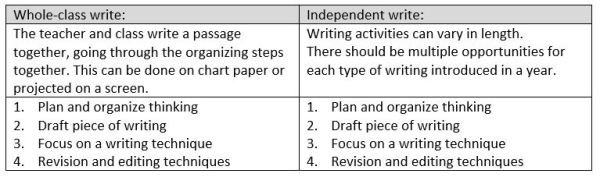
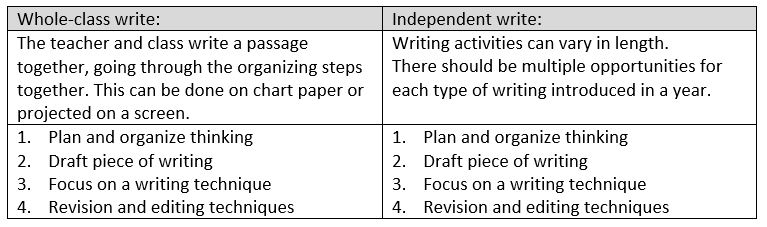
Adrienne Gear (2014) suggests the following lesson framework for each nonfiction form:
An introduction to the features of the nonfiction form.
This can be done by analyzing published examples of a nonfiction form.
Independent write and Whole-class write can be woven together in a We DO – You DO cycle.
With this framework in mind, the teachers of Rossignol Elementary worked in collaborative groups to write the following ideas for engaging their student writers:
Shared Writing About Writing
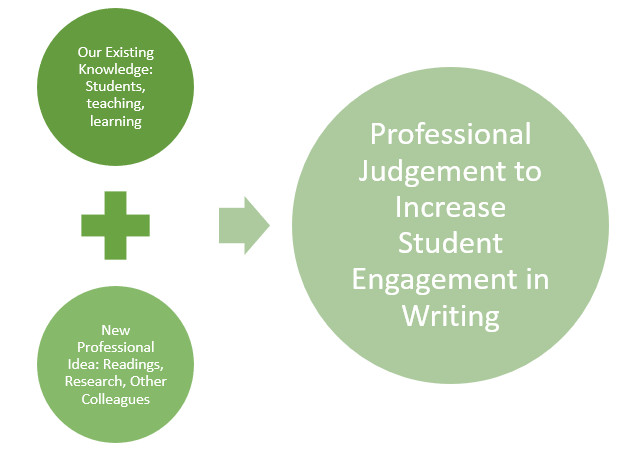
Engaging Student Writers is about the things that we can do as teachers to encourage students to write across all curricula. There are many different strategies that fit different grade levels and different content areas. It is important that we use our professional judgement to combine our existing professional knowledge, our knowledge of our students, and the new information we learn from our colleagues and research.
Drawing and Talking to Encourage Writing in Young Children
To encourage young children to write, have them group together to talk about a common experience (sliding, wiener roast, building a snowman). As children share information, the teacher can capture the vocabulary they are using.
Teachers can
Record on a chart or individual cards/word strips
Include a picture
Display in the classroom
Children can
take those word strips/cards and draw their own picture
describe/talk about their picture with an adult or older student
label the picture (either by the child or the adult/older student)
Differentiating Writing
How might we differentiate next steps? The sequence will depend on the age and ability of young writers.
Younger writers might have an older student or adult scribe a sentence for them. They can leave enough space underneath for the child to copy the words below.
Older writers might use the labels on their picture to write a sentence or sentences about their picture.
If students’ oral language skills are low, they can communicate meaning through the use of point pictures or flash cards. Key ideas related to the pictures can be created in advance by the teacher.
Extra Time for Encouraging Elementary Writers
There are many ways that we can encourage our elementary-aged writers in our classrooms.
When we give more time to write, we encourage writers to write more often. Allowing more time to organize their thoughts and ideas, using graphic organizers, modelling writing and brainstorming together can all contribute to student confidence.
Deadlines and expectations need to be communicated clearly so that students understand what needs to be produced and when it needs to be produced by.
Use technology like voice typing for those who can’t write as fast as they think can reduce frustration and get ideas out.
For those students who may be shy, strategies like passing notes, chatting 1:1 with peers about the topic, and think-pair-share can help to build confidence.
With extra time and strategies to maximize the time, students are allowed to process their thoughts and make meaning. This can help to show them that they ARE good writers.
Comic Book Writing for Engaging Writers
Comic book writing is when students write the dialogue into a blank comic template. There are various templates that you can download from sites such as this one from Scholastic.
Where to start? You might start with a “We Do” comic strip, then move to “You Do” by having students write dialogue into a given template with pictures already provided. They can then move to creating independently by choosing their template, and eventually creating their own pictures, characters and words either by using clipart or drawing their own original comic.
Mentor texts can include Manga, Amulet, Archie Comics or Marvel Comics. The use of mentor texts is key to introduce and discuss examples of dialogue and how words and pictures interact.
Comic book writing can encourage all types of writers, as it is a unique combination of visual/writing skills to tell a story.
What We Learned About Teaching Writing
I am thankful to the teachers of Rossignol Elementary for agreeing to their writing going out to an authentic audience on my Workshop Blog. By experiencing shared writing as adult learners, we discovered what some of the underlying anxieties and fears might be for our students. Worry about being wrong, worry about not being good enough, experiencing how daunting a blank piece of paper is all contribute to deepening our understanding of what to do for our students.
As adults, we experienced the power of writing to deepen our understanding of writing to a much deeper level than just reading about writing might have done. New knowledge, combined with our professional knowledge and knowledge of our students can help us to encourage our students to BE writing, not just engage in writing.
Gear, A. (2014). Nonfiction Writing Power. Markham: Pembroke Publishers.
Johanson, T., & Broughton, D. (2014). Exploring Comprehension in Physics. Saskatoon: McDowell Foundation.






 Terry Johanson Consulting